We see them everyday. We call them God’s Cattle. They are big. They are very big. They are so much bigger than any of us. We are frightened of them. When they run at us with their horns and their hooves, they can hurt us and make us bleed. They can even hurt us so much that we fall into the deep sleep which seems never to know waking. I have never seen any one of us waken from that sleep. Some of the older men and women say that one of us who falls into that deep sleep has gone home to God’s Cave forever.
But if we can be more wise than God’s Cattle, if we can make them fall into their own deep sleep, then they give us furry skin to keep us warm when the cold winds come down from the mountains. If we work together, with our long sticks with sharp stones tied tightly to their tips, then we can make God’s Cattle ours And when one of theirs is ours and we cut it and we put its flesh in the fire, the flesh smells good all the time it is cooking. And when we eat it, it fills the painful emptiness in our bodies and in our spirits.
But how can we be stronger than God’s Cattle? And how can we control so many other Beasts of God that are so much bigger and stronger than we are.’ Some of the older men and women say that we cannot; that in not a few winters from this winter, the Beasts of God will win and we will be no more. But I cannot believe that. Some say that if we draw God’s Cattle in painted pictures on the walls of our caves, they will become ours. Some say that God has given us God’s Cattle to help us stay warm and fed. Some say that we are God’s people. And that is what I and my family believe. Why do we believe that? How can we be sure? I do not know. It is something I hear in my heart. It is something that comes whispering into my heart like a gentle wind.
No Prehistoric woman or man wrote the above words. It is fictional, a modern writer’s attempt to enter into the mindset and the heart-feel of our ancient ancestors. They did not write these words. They may not have thought these thoughts or felt these feelings or had that faith. But they did paint those pictures. Absolutely. And we are amazed and affirmed, intrigued, puzzled, delighted, and confused because somewhere, in some mysterious depth of our contemporary consciousness, we know that we are connected. We know that cave. We have heard that whispering, gentle wind. We have been created to be creative. It has been true from the beginning, and it is still true today.
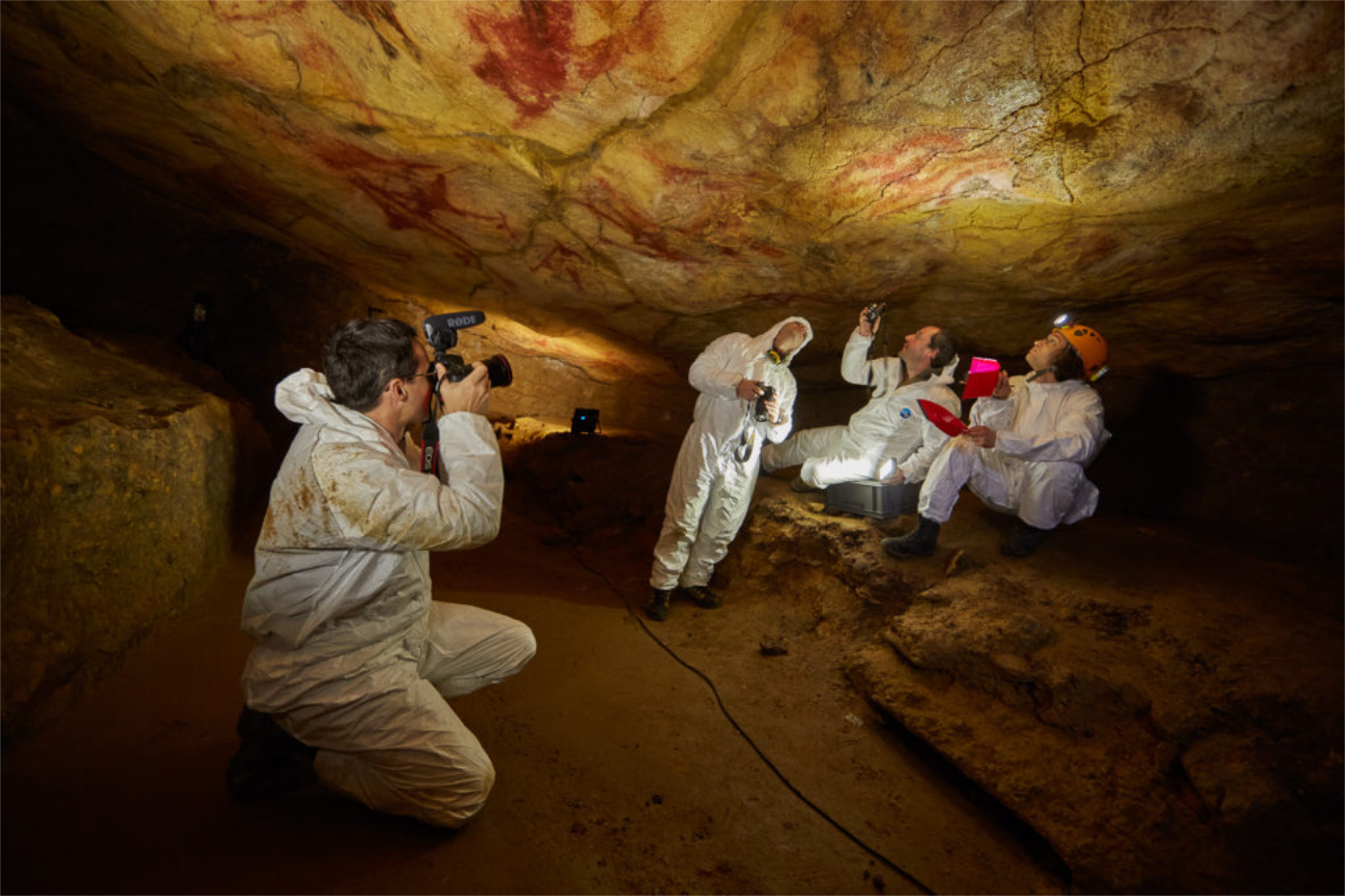
The paintings are all in the dark recesses of caves where it is always pitch black. What in the world are they doing there? The ancient artists invented stone lamps filled with fiery animal fat to enable them to see what they were painting. Why did they bother? How did they achieve the spectrum of colors used: reds and browns, yellows and ochres and various shades of charcoal? Why did they bother to diversify hues? And if they painted on underground cave walls which have lasted thirty thousand years for our contemporary viewing, can we not be reasonably certain that they painted on other surfaces as well, surfaces which simply did not last: wood and bark, bone and skin? It seems most likely. But the more important question still remains: why did they paint at all? Was it to have some control over what seemed hardly controllable? Was it to have some mysterious power over what seemed so much more powerful than themselves? That certainly seems a more reasonable explanation to us today than an aesthetic conclusion that the cave paintings were painted simply to be beautiful paintings. But who knows?
There are deep, dark caves filled with wonderful Paleolithic paintings in places like Altamira in Spain (discovered in 1879) and, in France: Lascaux and the Hall of Bulls(1940 Cap Morgiou near Marseilles (1991),) and Vallon Pont d’Arc in the Ardeche (1994). In fact, to date, over two hundred caves have been discovered with Paleolithic drawings of horses and bison and lions and rhinos and elk and even (in Cap Morgiou) seals and penguins. And while the occasional depictions of human beings found on cave walls make our ancestors look like simple stick figures, the beautiful animals have been drawn with as careful attention to detail and feeling as any art that has followed down through the ages
Perhaps a gentle, whispering wind has been blowing beside the entrances of our many, different caves for many thousands of years.