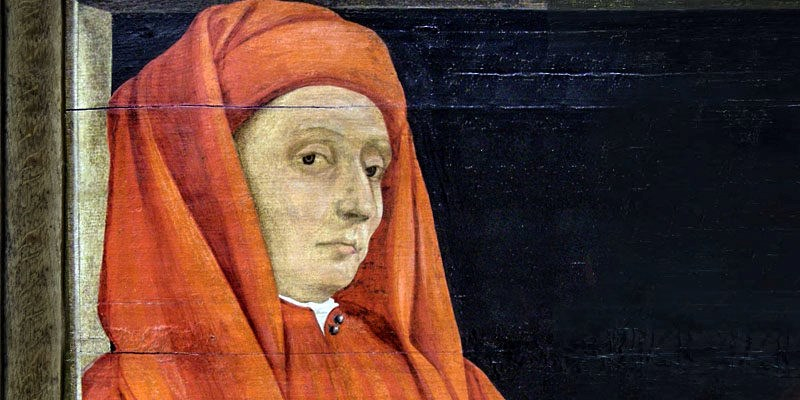
A gentle, whispering wind brings us next to the entrance of a Gothic chapel. We look inside the entrance and see that an artist is painting scenes from the lives of Jesus and Mary on the walls of the chapel. The chapel is the Arena Chapel in Padua. The year is 1305. And the artist is Giotto (1267- 1337). We notice that Giotto is brushing his paint pigments onto a small area of the wall which is covered with a wet plaster he has made out of lime, sand and water. The method he is using ensures that pigments and plaster will dry together and that his painting will last a long time. This is a great advantage. The disadvantage is that the artist must work quickly on the necessarily limited area he has covered with plaster before the drying process begins. This method is called buon fresco or true fresco. And Giotto seems very ready for the challenge.
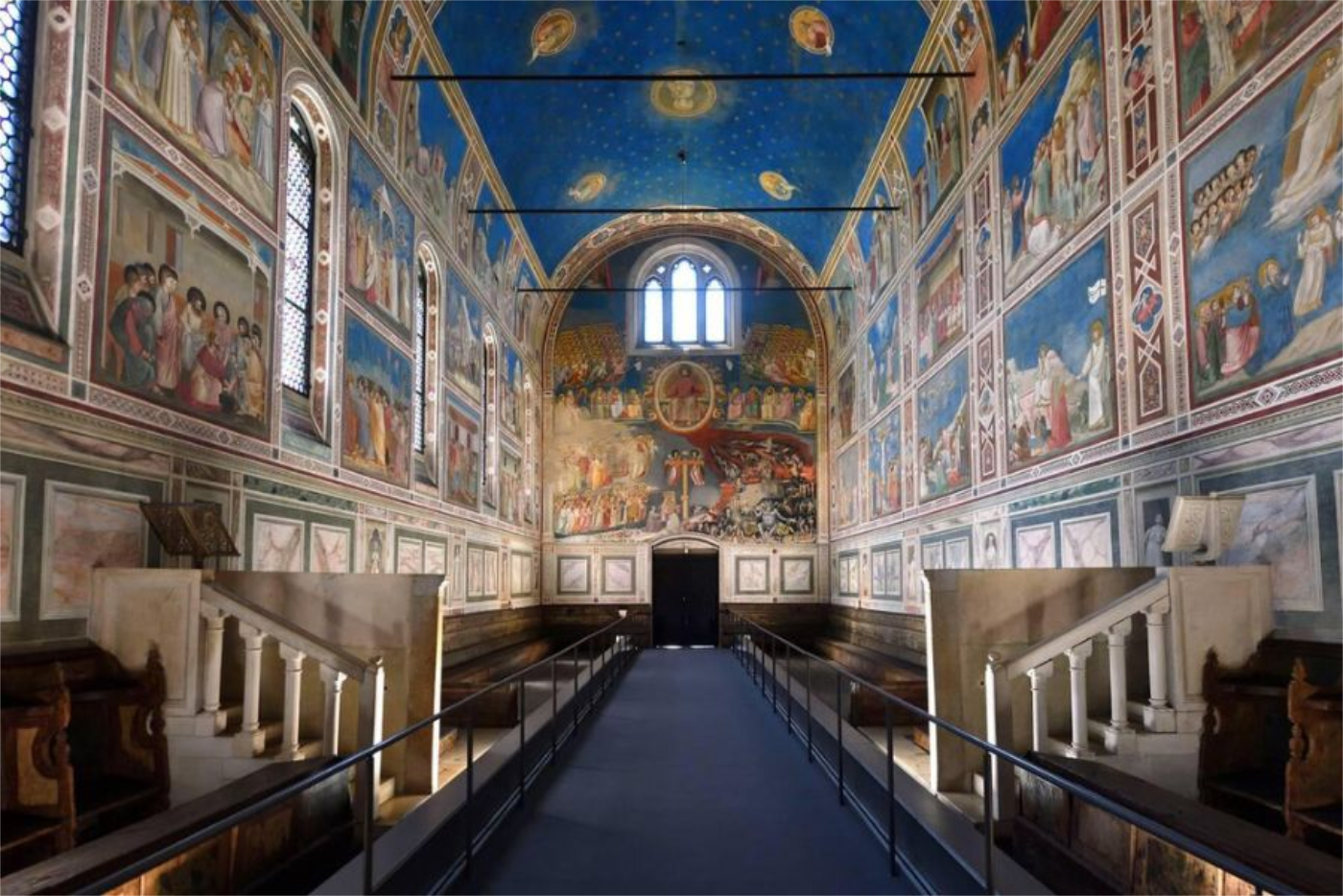
We watch him paint for a while and then walk around the chapel to examine scenes which the artist has already completed We pause for a long time in front of a fresco called, “The Deposition of Christ.” Jesus has been taken down from the cross and placed in the arms of Mary, his Mother. The painting is almost square: 6ft 7 in x 7 ft 7 in. We enter into the scene and find ourselves in a whole new world. The painting is passionately alive with human interrelationship. This emphasis on humanity is an early harbinger of the world to come, the world of the Renaissance.
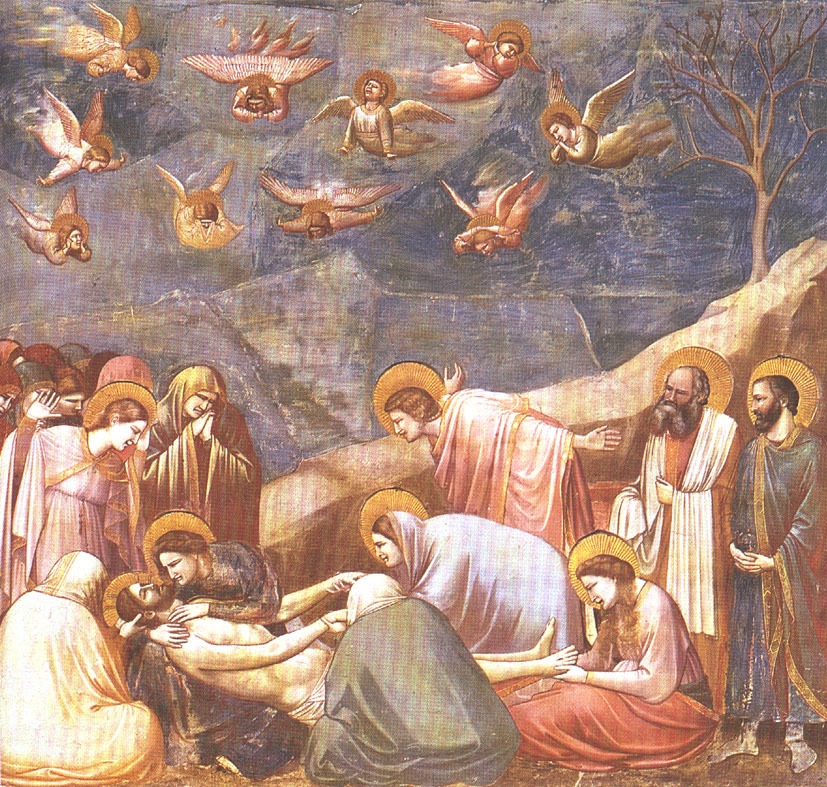
In Giotto’s frescoes, we find real people acting and reacting at moments of peak emotional involvement. Every single character is always looking at someone else. And every single character is in a real physical space. Gone is the all-purpose medieval back-drop of blue or gold. Gone is the stiffness of isolated figures looking neither at one another nor at us. Here, in Giotto, is personal, emotional, intense, human relationship. The gentleness and the freshness and the coloration are still Gothic but we are clearly moving into the humanism of the Renaissance. That is why Giotto’s work is so frequently cited not as Medieval but as Pre-Renaissance.
And Giotto’s “Deposition of Christ” is a Pre-Renaissance Pieta. Mary pulls Jesus’ face up close to her face. She stares at him intently. She seems to be watching for breath to come out of his nostrils again, for his lips to move even ever so slightly, or, please God, for his eyes to open. But his face is still and calm and facing straight up to the heavens. Mary rests the dead weight of her son’s strong back upon her knee and continues to stare at him. She seems strong and majestic for all her pain. She is not crying. She is deeply, intimately, contemplating the face of her crucified son. Above her, other women are crying. And above them, the angels of heaven fill the heavens with their anguish and their tears.
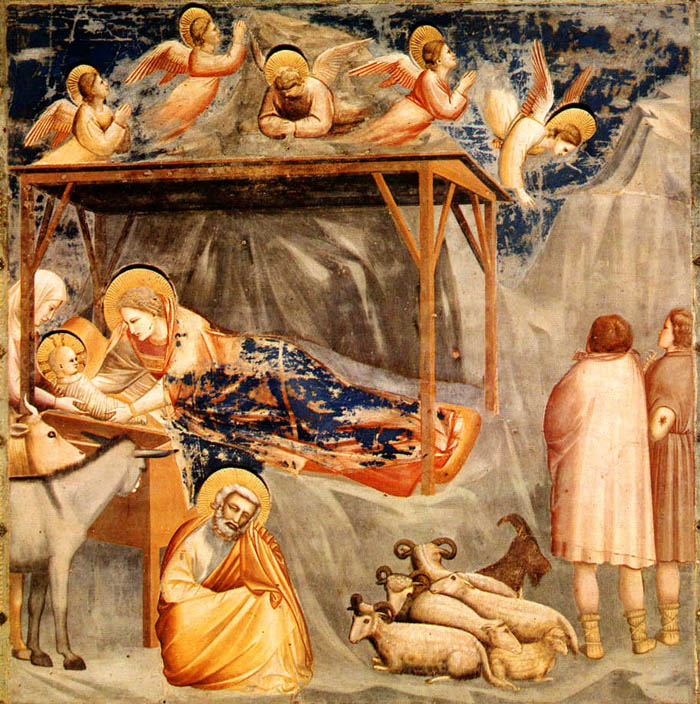
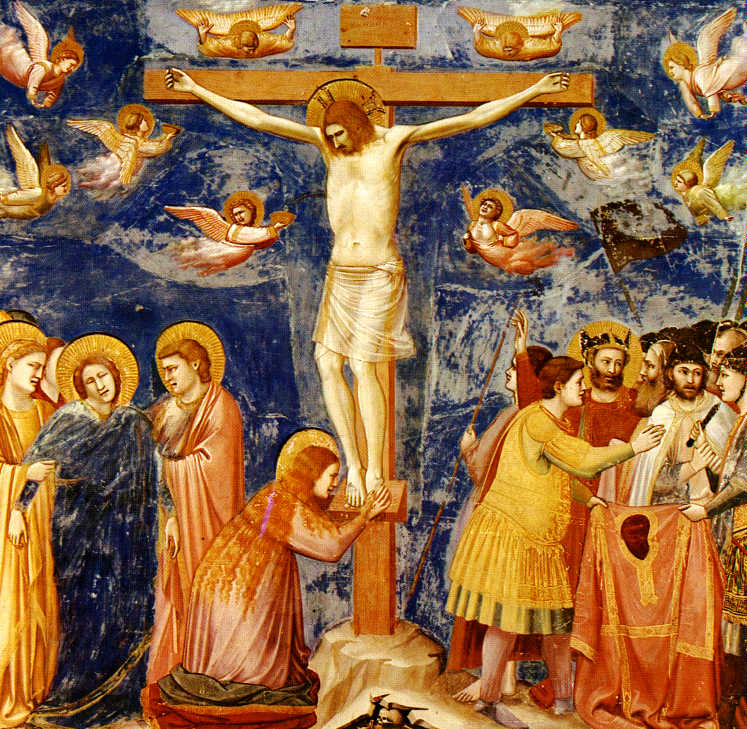
In Giotto’s fresco of the “Birth of Christ,” we saw angels rejoicing in heaven, singing and speaking to the shepherds, telling them the great good news. In Giotto’s fresco of the “Crucifixion,” we saw angels catching the blood from his wounds as hung dying on the cross. But now it is all over, stupidly, horribly, painfully over. And the angels in Giotto’s fresco of the “Deposition of Christ” are in agony. We notice, in particular, the third angel from the left, near the top center of the fresco, pushing its arms and hands down as if to push the whole scene away and make it disappear, make it not be true. And all the while, the angel’s head is thrown back and its mouth open and sobbing.
Directly under that sobbing angel’s left hand, we see John, the beloved disciple who rested his head on the chest of Jesus during their last meal together. Here John throws back his hands as far as they can go, open to do anything he can to make this pain not be. John physically pushes his chest and his heart out toward Jesus and Mary. There are tears in his eyes and pain and denial in his face. One of the very last things Jesus had said from the cross was to place John and Mary into each other’s care. “Woman, behold your son,” Jesus had said to his Mother, Mary, and then to John, his beloved disciple, “Behold your Mother.” In Giotto’s fresco, John looks like a man who has heard and who has accepted – but who hurts – with all his heart.
Below John’s left hand, we see Mary Magdalene, holding the feet of Jesus which once she had anointed for his death, holding his feet now and staring at them, staring at the horrible wounds in his feet from the nails which had held him on the cross. She had washed those feet with her tears and dried them with her long hair. She was a new woman because of this Jesus, and now he was dead. His eyes had looked deeply into her and had seen her as someone good, someone beautiful. She had come to believe in herself because she had come to believe in him. She had come to see herself the way he saw her. But now his eyes were closed in death. She holds his feet. She just stares at his feet and weeps.
Behind Mary Magdalene, we see Joseph of Arimathea and Nicodemus standing deep in thought, looking at the dead body of Jesus in Mary’s arms. Jesus had taught them that they must be born again if they were to be his disciples. But now he was dead. How could this be? What about their dreams? What about the new people they had become because of him? How could they possibly continue now without him? What about his promises? He promised that he was the Resurrection and the Life. He promised that they who believed in him would never die. He promised that he was going to prepare a place for them. How could this be?
Above Joseph and Nicodemus, there is a rocky ledge with a lone, bare tree upon it. And above that, there is a sky filled with mourning angels. But it is a slate-blue sky that is letting a wonderful, new, soft light come through it. We look again at the strength of Mary’s face staring into the face of Jesus. And we can hear again, with Mary, the words spoken to her by her cousin Elizabeth so long ago, while she was carrying her child in her womb, “Blessed is she who trusted that the Lord’s words to her would be fulfilled.”