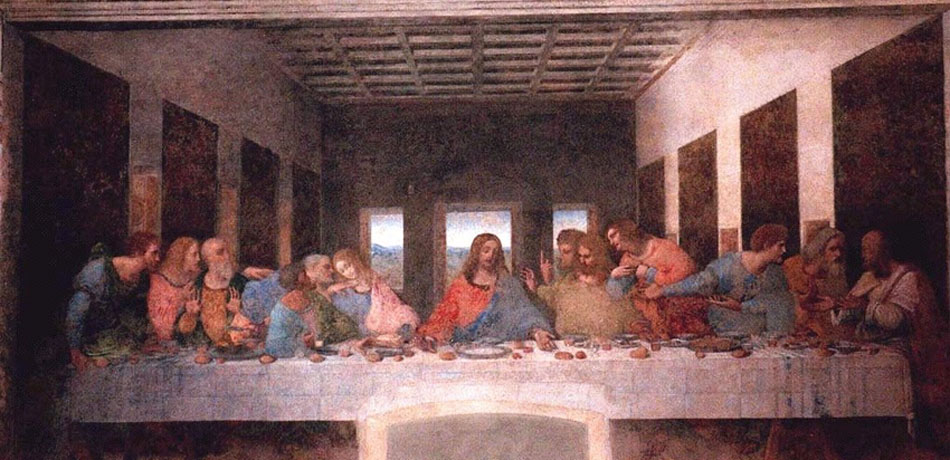
With a gentle wind beneath our wings, we fly from Padua to Rome, Florence and Milan. It is now some three hundred years later. We are going to contemplate three very different Pietas all sculpted by one extraordinarily gifted artist. His name is Michelangelo Buonarroti, seen here in a self-portrait.
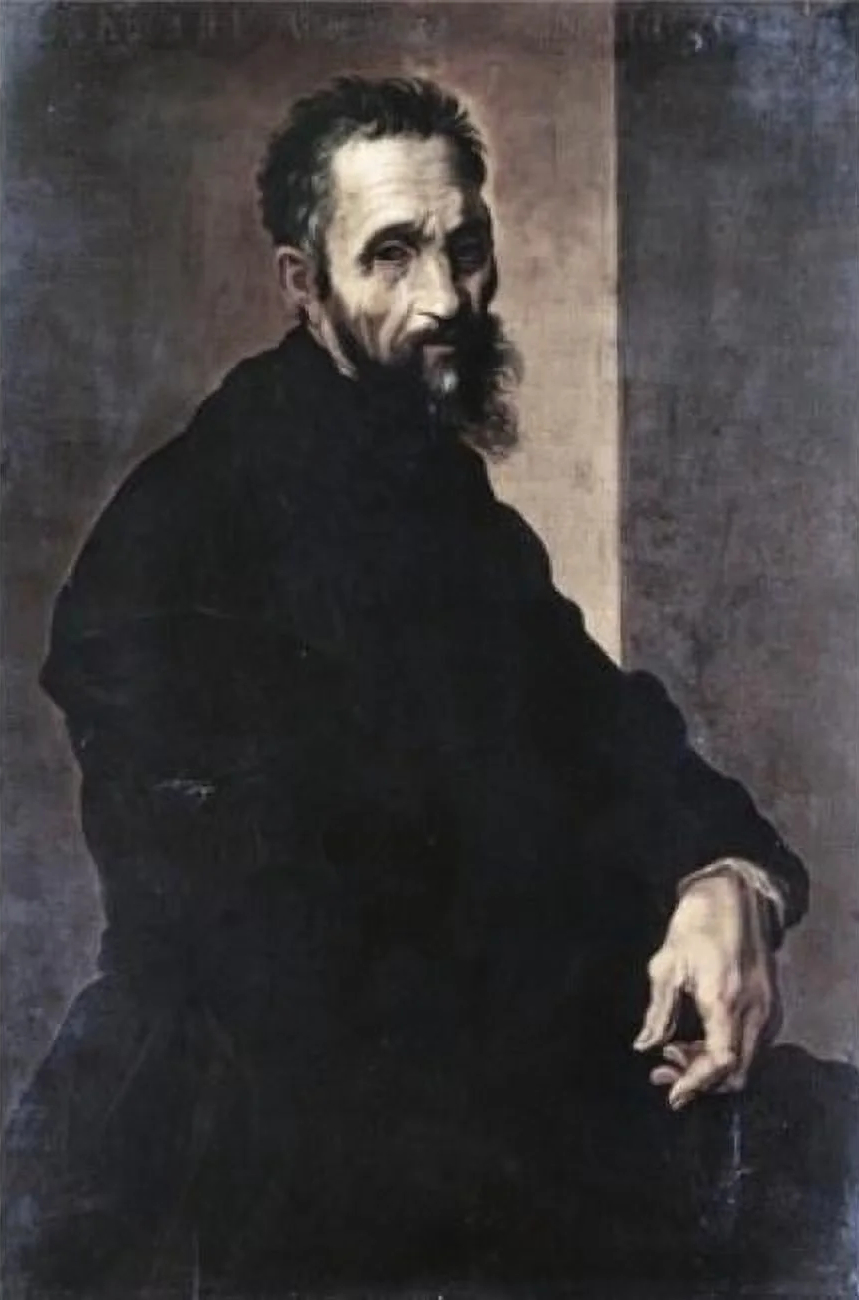
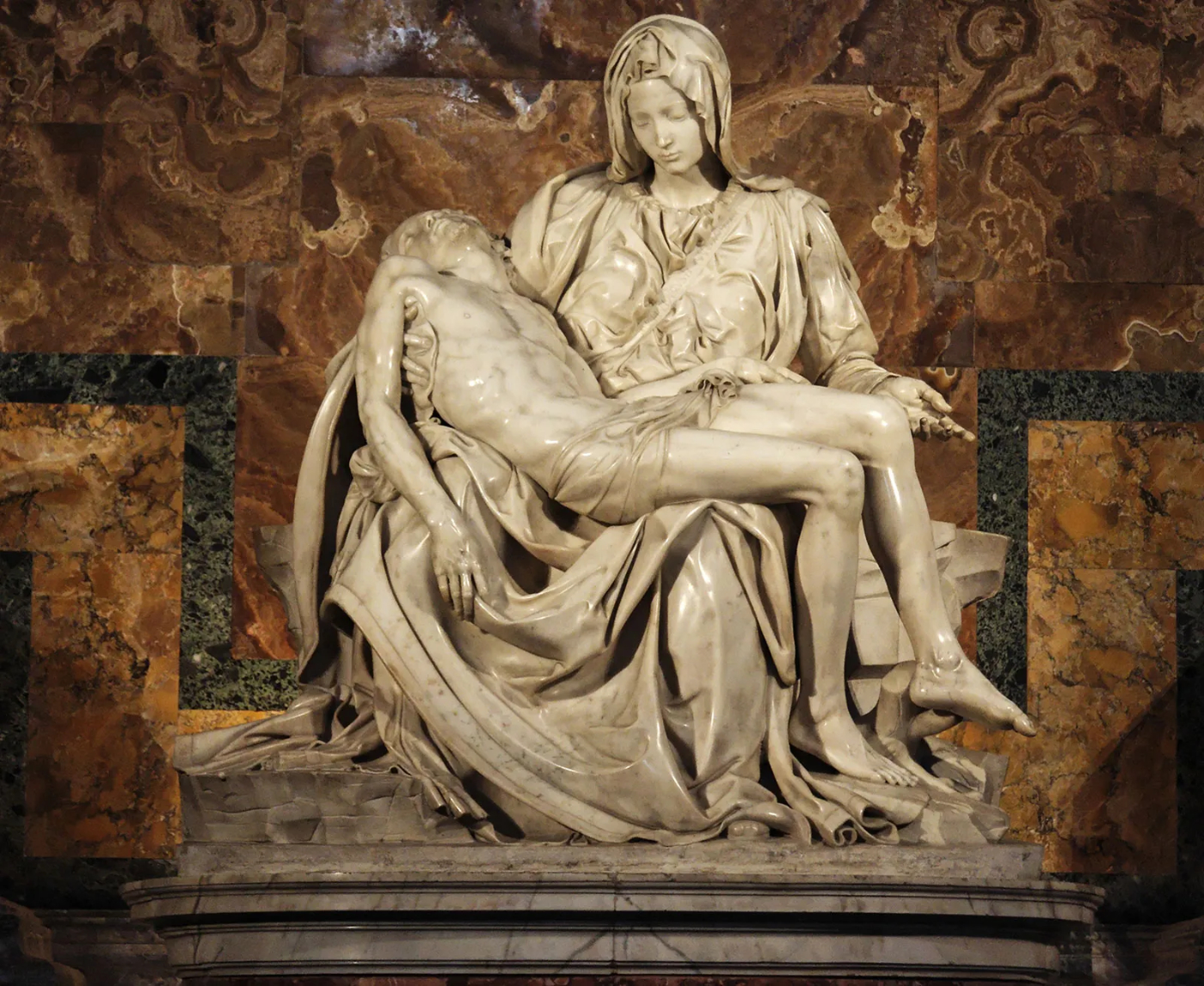
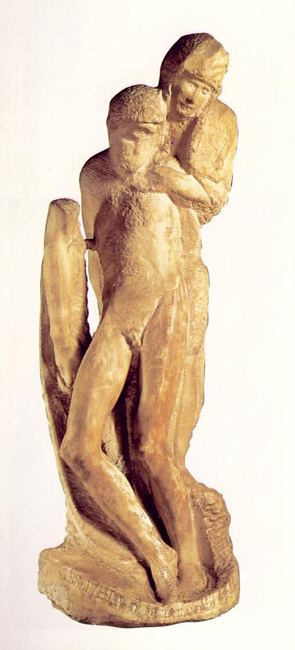
Michelangelo was only twenty-three years old when he carved the Pieta for St. Peter’s Basillica in Rome. He was eighty-nine years old and dying when he last worked on the Pieta which is now in Milan. The Pieta in Rome is polished and perfect and unquestionably one of the best known and most loved works of art in all the world. The Pieta in Milan seems crude and unfinished and is, when we know the story of its creation, one of the most moving works in all the world.
Michelangelo is a Renaissance artist. That phrase describes someone who is multi-talented, who delights in the glory of being human, and who searches diligently for knowledge and truth, beauty and understanding. Renaissance artists literally made themselves sick studying human anatomy by dissecting cadavers. But they had to know. They had to know everything. They had to know every bone, every muscle, every fact and every possibility.
Encountering Michelangelo’s first Pieta would, in itself alone, convince us that this particular Renaissance artist had indeed learned everything. And more, that God had shared with Michelangelo an awe-inspiring power to communicate spiritual beauty in human form. It was a great gift that Michelangelo used well. The great sculptor explained that he would just look at a huge block of marble and see within it the statue that needed to be freed. Its job, as he humbly saw it, was simply to take hammer and chisel and keep working until he had chipped away all extraneous marble. Then the sculpture inside would be released and revealed
We contemplate the lifeless right arm of Jesus and marvel at the veins running beneath the surface of the skin; the gathering of flesh in the upper arm where his mother’s right hand holds him, the musculature of forearm into wrist, into hand; the knuckles and the fingernails. And we marvel that all this breathtakingly perfect anatomy has been painstakingly chipped out of an enormous block of marble by an enormously talented twenty-three-year-old Florentine.
But there is more. And it is even more amazing, more Renaissance, more Michelangelo. We study more carefully the proportions of Jesus left hand closed in death and compare them to the proportions of Marys left hand open in gift.. We compare Mary’s left arm and Jesus’ left arm. We compare Mary’s face bowed gently forward in serene resignation to God’ will and Jesus’ face, peaceful as if he rests his head in sleep upon his mother’s right arm. We compare Mary’s body and Jesus’ body. And we come to the amazing realization that Jesus and Mary have been sculpted on different scales. Jesus’ body is in perfect anatomical proportion to itself. Mary’s body is in perfect anatomical proportion to itself. But the body of Jesus has been sculpted on a slighter smaller scale than the body of Mary, not so much that the viewer is distracted but enough so that the body of Jesus fits comfortably on Mary’s lap.
Remember the great difficulty artists had always had representing with any grace, the large, dead body of Jesus on the small lap of his grieving mother, Mary. The Medieval carver solved the problem by giving Jesus the proportions of a dwarf: This particular Renaissance artist solves the problem with a dizzyingly delightful grasp of anatomy, optics, and mathematics. Michelangelo also gives Mary’s slightly larger-scaled body even more mass by the great Baroque flow of her garments. Large folds of fabric undulate everywhere, helping to make this mother’s lap a perfect resting place for the heavy body of her dead son
Nor does Michelangelo make the body of Jesus look heavy. The body of the crucified Savior is smoothly polished perfection, emanating a strangely serene light. To be sure, there are wounds in his hands and his feet and his side. But this is not a battered, swollen, broken body which has just been taken down from the cross after having hung there, in agony and torture, for three horrible hours. Michelangelo is not trying to represent the historical moment of the actual deposition but the eternal reality of Jesus and Mary as very real and sacrificially loving persons in his life and in ours. Consider this: at the historic moment, Jesus would probably have been about thirty-five years old and Mary about fifty. In Michelangelo’s representation, Jesus and Mary both seem to be about twenty-five, in the prime of life, in an eternal now, as they shall be – as we all shall be – forever. The young artist in the prime of his life is in mystical union with Jesus and Mary in their eternal prime of life.
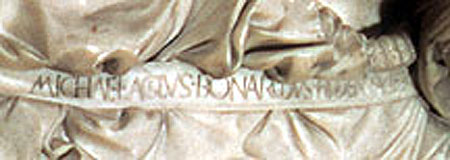
On the band that runs between Mary’s breasts, Michelangelo carved the words “Michelangelo hoc fecit” which means ‘Michelangelo did this.” He certainly did. It is, in fact, his only signed work. And he signed it because he had overheard some women in St. Peter’s trying to guess who carved this new Pieta which they found suddenly installed right here before their very eyes. And nobody, for all their guessing, mentioned his name. So the young sculptor signed his work.
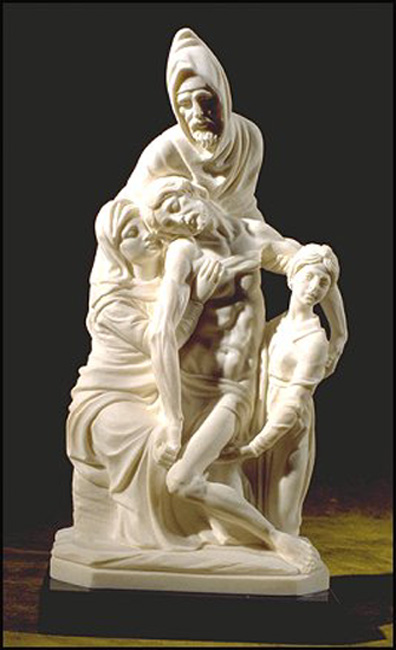
Next time, we find Michelangelo in the Pieta himself! We leave Rome and go to Florence and discover that the face of Joseph of Arimathea in Michelangelo’s Pieta there, is the face of Michelangelo (broken nose and all) himself. Joseph stands holding the dead body of Jesus. He looks sad as he identifies with the dead savior. Michelangelo shares that identification. Mary, the mother of Jesus, is holding her son’s body on his left side. And, talking about scale and proportion, we are startled to see the figure of Mary Magdalene on the right side of Jesus. We are startled because we know that Michelangelo non hoc fecit. Michelangelo could not possibly have done this. This proportion of Mary Magdalene is not only too small but distorted. This is a figure that is obviously out of place in this masterpiece. We are relieved to learn that Michelangelo did not complete the Pieta himself. A student finished, and ruined, the figure of Mary Magdalene.
We are reminded once again of the importance of proportion and scale. And we marvel once again at the miracles of proportion and scale achieved by Michelangelo in the Pieta in Rome.
Then we fly to Milan to experience our third and final Pieta by Michelangelo, a sculpture he had been working at, on and off, for many years, up to and including the year of his death. We might expect the work of the eighty-nine-year-old master to be even more polished and perfect than the work of the genius of twenty-three. And we might be shocked to discover that it is not. But it is, if possible, even more moving.
There are only two people in this Pieta: Jesus and Mary, two people who share mystical intimacy with one another – and with Michelangelo. Michelangelo’s struggles with this sculpture during the last years of his long life were struggles to portray this intimacy more and more strongly. In the end, he moved the head of Jesus closer to the head of Mary by transforming Mary’s right shoulder into a newly carved head for Jesus. Mary had been standing further off to Jesus’ left, holding up his lifeless but ethereally light body. Now his head was right next to her head. Was it really all over? Or was it all just really beginning? For Jesus? For Mary? For Michelangelo?
Michelangelo believed what he believed. He moved Mary and Jesus as close together as he possibly could, even as he himself prepared to move in with them. Had not Jesus promised, “I go away to prepare a place for you that where I am you may be.”? Had not Jesus prayed for us the night before he died, “Father, that they may be one in us, as you, Father, are in me and I in you; I pray that they may be one in us.”?
Michelangelo would answer yes. Intimately, personally, Michelangelo knew and loved the God he discovered in the gentle, whispering wind.