What a delightfully natural child! How perfectly human the Word-Made-Flesh looks here in Michelangelo’s gentle representation. This Jesus is no unreal little man. This Jesus is a real little boy. We notice his chubby face and fingers. We notice his chubby knees and toes.
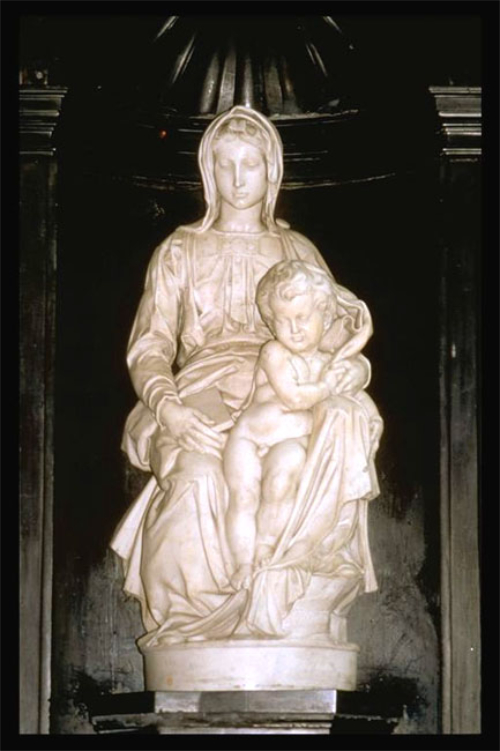
Jesus’ pudgy little fingers hold on to his mother. Jesus’ pudgy little toes look like they are itching to get going. This little boy looks like he wants to stay and, at the same time, he looks like he wants to play. Maybe it is the age. Jesus seems to be about two years old, and this two-year-old looks like he wants to stay where he is so secure, standing snugly between his Mother’s knees. But he is not looking at his mother. He is looking down. Something on the ground below has caught his attention. He wants to go get it. He wants to go discovering. But he doesn’t really want to let go just yet. The fingers of his right hand are entwined with the fingers of his mother’s left hand. He is holding on. His left arm and hand are wrapped around his mother’s left thigh. He is holding on. But those toes, those perfectly imperfect little human toes, those toes want to go.
What would his mother think? Jesus does not look at his mother’s face. So we do. Her face looks so sad. She seems a million miles away. What would his mother think? His mother, as a matter of fact, looks deeply lost in thought. Her face and head covering are very much like her face and head covering in the Pieta which Michelangelo sculpted about five years earlier, the Pieta in St. Peter’s in Rome. Mary’s face in the Bruges Madonna is just as strong and just as beautiful as it is in the Pieta but is infinitely sadder.
We wonder why. It seems somehow strangely opposite of what we would expect. A mother holding her charming little boy should look happy. A mother holding the corpse of her crucified son should look sad. Isn’t that the way it should be? Doesn’t that make sense?
But then we see the book in Mary’s right hand. And we remember the scriptures which prophesy how much the Messiah will suffer. Mary’s face reveals the pain of meditating upon those readings. Mary’s face in the Bruges Madonna looks deeply anguished because it is the face of a woman whose heart breaks upon discovering the enormous sacrifice that will be asked of her and her beautiful little boy. Mary’s face in the Pieta looks peaceful and resigned because it is the face of a woman intimately involved in God’s great gift to God for all the human race.
Mother and Son are more intimately one in purpose and heart and gift in the Pieta than they are in the Bruges Madonna. At the point in time that was Golgotha, Mother and Son had already been through so much together and, in some mysterious way, would always and ever be together. But in the Bruges Madonna, the parent is parent, and the child is child. In a very real sense, the protective and nurturing parent here is terribly alone and anxious and afraid for the well-being of her son. And her son, her Jesus, was pulling away to go and play, to go and grow and live and love and die. What did he know? How could he possibly understand? How could she possibly protect him?
Michelangelo knew Mary’s love and her sorrow.
Michelangelo who moved Jesus and Mary as close together to each other as he possibly could in his last Pieta, the sculpture he was still working on before he died, understood pain and frustration – and intimacy and peace. Michelangelo, like Mary and Jesus, was in God’s hands. And God, who is in the gentle wind, was in theirs.