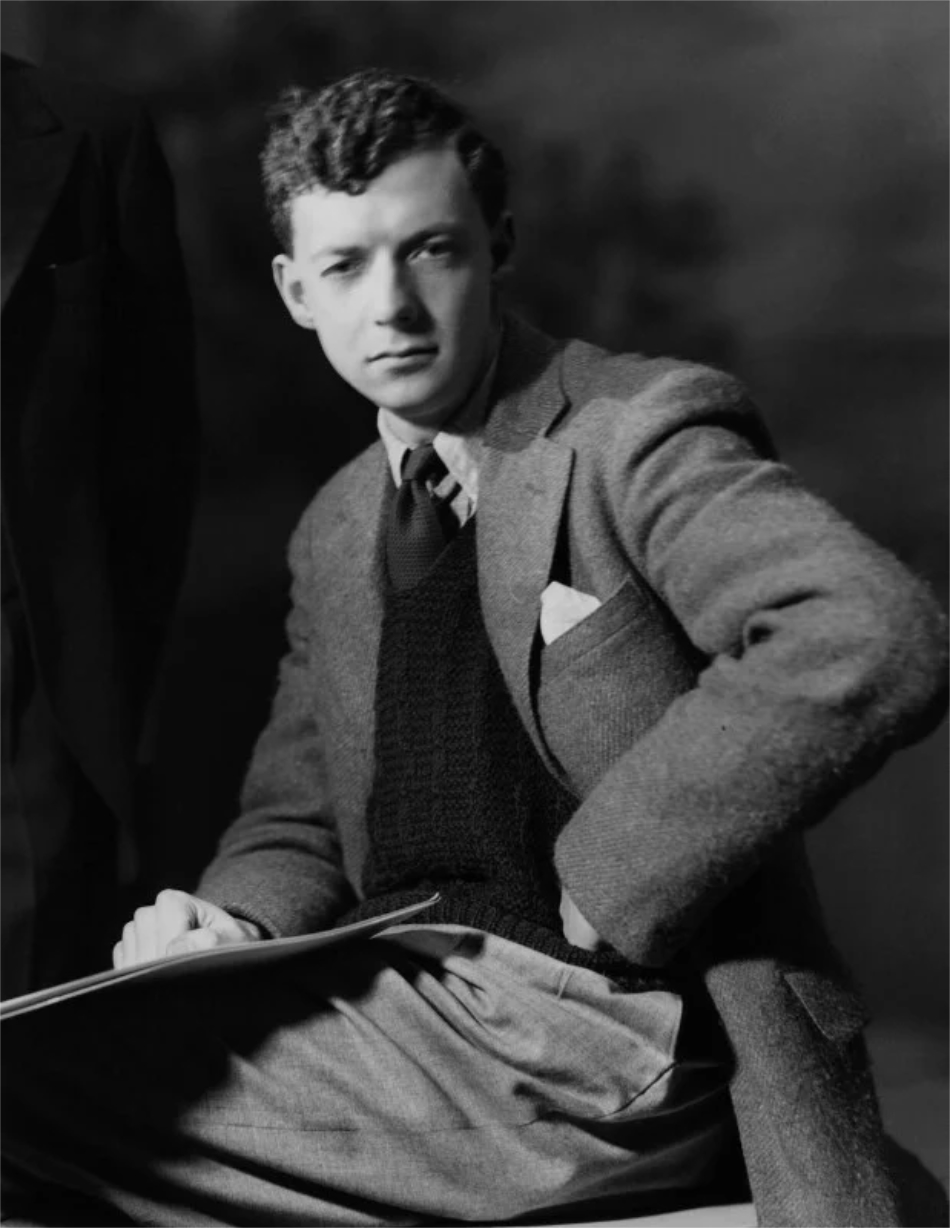
Benjamin Britten (1913-1976) wrote his “War Requiem“ to celebrate the restoration and consecration of St. Michael’s Cathedral at Coventry on May 30, 1962. It is scored for soprano, tenor, baritone, mixed chorus, boys’ choir, full orchestra, and chamber orchestra. Britten includes in his text most of the text of the Latin “Requiem Mass” and nine poems written by the English poet, Wilfred Owen.
Owen was a soldier-poet whose heart and words opposed the senselessness, futility and cruelty of human beings killing each other in battle after battle. Owen’s heart and words sing touchingly, often bitterly, with pity and with pain, for the people who die in war. He himself was killed in World War I just one week before the armistice and a little while after he had received the military cross for bravery.
Benjamin Britten shared the pacifist convictions of Wilfred Owen and makes his own the lines of Owen’s which appear on the title page of the “War Requiem,” “My subject is War, and the pity of War. The Poetry is in the pity. All that a poet can do is warn.” Britten’s creative choice to juxtapose Owen’s poems with the Latin “Requiem Mass” text results in many ways in a Requiem not really for the dead, nor even for the living, but rather a Requiem for the dying. If we continue to slaughter each other, Britten and Owen warn, our world is doomed
In the plans for restoration of St. Michael’s in Coventry. It was deliberately decided that one large window in the new St Michael’s Cathedral would be filled with clear rather than stained glass in order that the faithful might look out and see the ruins of the ancient St. Michael’s church. Let us look carefully, the restorers asked, at what is left of that lovely old stone church where the ancient “Requiem Mass” had been sung for centuries and which, tragically, had been one of the first edifices destroyed by Nazi bombs in World War II. Let us look and remember the horror of war. And let us try to live in peace. Britten’s “War Requiem” commissioned and composed specifically for the dedication of the new St. Michael’s – captures these sentiments perfectly.

The gigantic work begins disturbingly with bells tolling F sharp to C natural over and over again while the chorus sings the Introit, “Requiem aeternam dona eis, Domine… Eternal rest grant unto them, O Lord…” repeating those same two tones constantly with more and more feeling. Brittens creative use of this tritone as a two-note motif is the most important unifying device in his “War Requiem.” These two tones were once called the “tonus diabolus” and were forbidden for centuries in polyphony. The tritone still sounds dissonant and disturbing to modern ears. Britten knows all this and capitalizes on it.
After “Et lux perpetua luceat eis… and let perpetual light shine upon them…” four bells clang and clash together a double tritone as a chord Britten emphasizes the horror of the death of so many thousands of young soldiers. He will not let the congregation emphasize the consolation of light.
But then, suddenly, the boys’ choir is singing with organ accompaniment and all seems peaceful and heavenly and, above all, innocent. The melody for the boys’ singing the psalm verse, “Te decet hymnus Deus in Sion… A hymn is fitting for thee, O God, in Sion…” begins not with the tritone but with a perfect fourth: C. F. above them, however, the strings murmur the “tonus diabolus:” C and F sharp until, in their final notes, the boys sing that interval of mourning and pain themselves. And war is the more hellish for the innocents that are slaughtered in its corruption.
The first of Owen’s poems is now introduced. Its title, appropriately, is “Anthem for Doomed Youth.” Bells sound the tritone until the chamber orchestra comes in with that same tonal progression sounded on the harp. The tenor begins singing the poem, “What passing-bells for these who die as cattle?” Oboe, clarinet horn, bnassoon and flute in a low register murmur the melody of the boys’ “Te decet hymnus” throughout the tenor’s singing of Owen’s poem.
Bells again toll the mourning motif of the tritone and repeat this painfully sorrowful sound after the first two unaccompanied petitions of the “Kyrie.” After the third petition, however, Britten admits a moment of peace and a gentle chord of F major. Subtly the change on one note, F sharp to F natural, is peace and an answer to painful prayer. Britten makes the very power of the tritone to disturb, here serve to soothe – but only for a moment.
Military calls on trombone, trumpet and horn indicate that Britten’s “Dies Irae,” as Owen’s, is played on battlefields where countless hosts of young soldiers have been killed.
The tension of the long “Dies Ime” is mercifully eased by the innocent voices of the boys’ choir, singing antiphonally and accompanied by organ, praying the opening words of the Offertory, “Domine Jesu Christe, Rex gloriae… Lord Jesus Christ, King of glory…” This is followed by a fugal section for full orchestra and chorus singing, “Sed signifer sanctus Michael repraesentet eas in lucem sanctam… But let your standard-bearer, holy Michael, lead them into the holy light…” There is a rather incredible optimism and hope in Britten’s happy setting of the “Quam olim Abraham promisisti et semini eius… As you once promised Abraham and his descendants forever.” God has promised, and it must be so. There shall be life and peace. God promised Abraham and his descendants forever.
But then baritone and tenor soloists tell the story of Abraham and Isaac in the chilling poetic version written by Owen. It is a terrible version. For when the angel tells Abraham not to slay his son, Isaac, Britten recalls the first bugle call and Owen changes the ending of the story horribly. “But the old man would not so,” he says, “but slew his son, and half the seed of Europe, one by one…” While the soloists repeat that last line over and over and over again, bitterly and tragically, the boys’ choir sing the verse of the Offertory, “Hostias et preces… Hymns and prayers…” and both the prayer and the praise are painfully bitter for the association with the poem’s conclusion.
Chorus and orchestra repeat the “Quam olim Abrahae promisiti” but now not as loudly as before. The pianissimo and the preceding poem make the promise sound painfully hollow, tragically unfulfilled because people – not God but people – have refused to allow it to be fulfilled.
And so the following “Sanctus” begins with the clanging of percussion, cymbals, glockenspiel, vibraphone and bells. They clash out F sharp while the soprano soloist and chorus sing, “Sanctus, Sanctus, Sanctus… Holy, Holy, Holy” and then they fall back to the C. There is the tritone again, the “tonus diabolus” again. There is praise for God but mourning for God’s people. There is pain again.
There is more pain in Henryk Gorecki’s “Symphony No. 3” which is subtitled, “Symphony of Sorrowful Songs.” Gorecki was born in Poland in 1933 and wrote this work in 1976. Amazingly, a recording of the work on Electra Nonesuch CD – with soprano Dawn Upshaw and the London Sinfonietta conducted by David Zinman – was purchased, experienced and embraced by hundred of thousands of people in Great Britain (where it became enshrined in the pop-charts in the top-ten) and in the United States (where it remained Number 1 for 23 weeks on the Billboard classical chart) in the mid 1990’s!

The first of the three movements of this “Symphony of Sorrowful Songs” begins very slowly and softly with double-basses repeating their low dirge. Other strings enter in fifths, rising, rising, rising through four octaves. Finally, the strings reach their height and unite in eight-part polyphony. The strings then serve to support the lamentation they have introduced. The song is sung in Polish by a soprano soloist and is, in fact, a lamentation composed in the Monastery of the Holy Cross in Poland in the second half of the 15th century. We hear the Virgin Mary, the Mother of Jesus, mourning the death of her Beloved Son.. We experience the pain of the Pieta again.
The Polish words somehow feel prayerfully poignant even to the ear that does not understand Polish, perhaps because the lamentation is so beautifully sung by Dawn Upshaw. Translating, we hear the Mother of Jesus sing, “My son, my chosen and beloved/ Share your wounds with your mother/ And because, dear son, I have always carried you in my heart,/ And always served you faithfully/ Speak to your mother, to make her happy,/ Although you are already leaving me, my cherished hope.”
Mysteriously, tenderly, poignantly, lovingly – even here in modern times – God is in the gentle, the weeping, the whispering wind