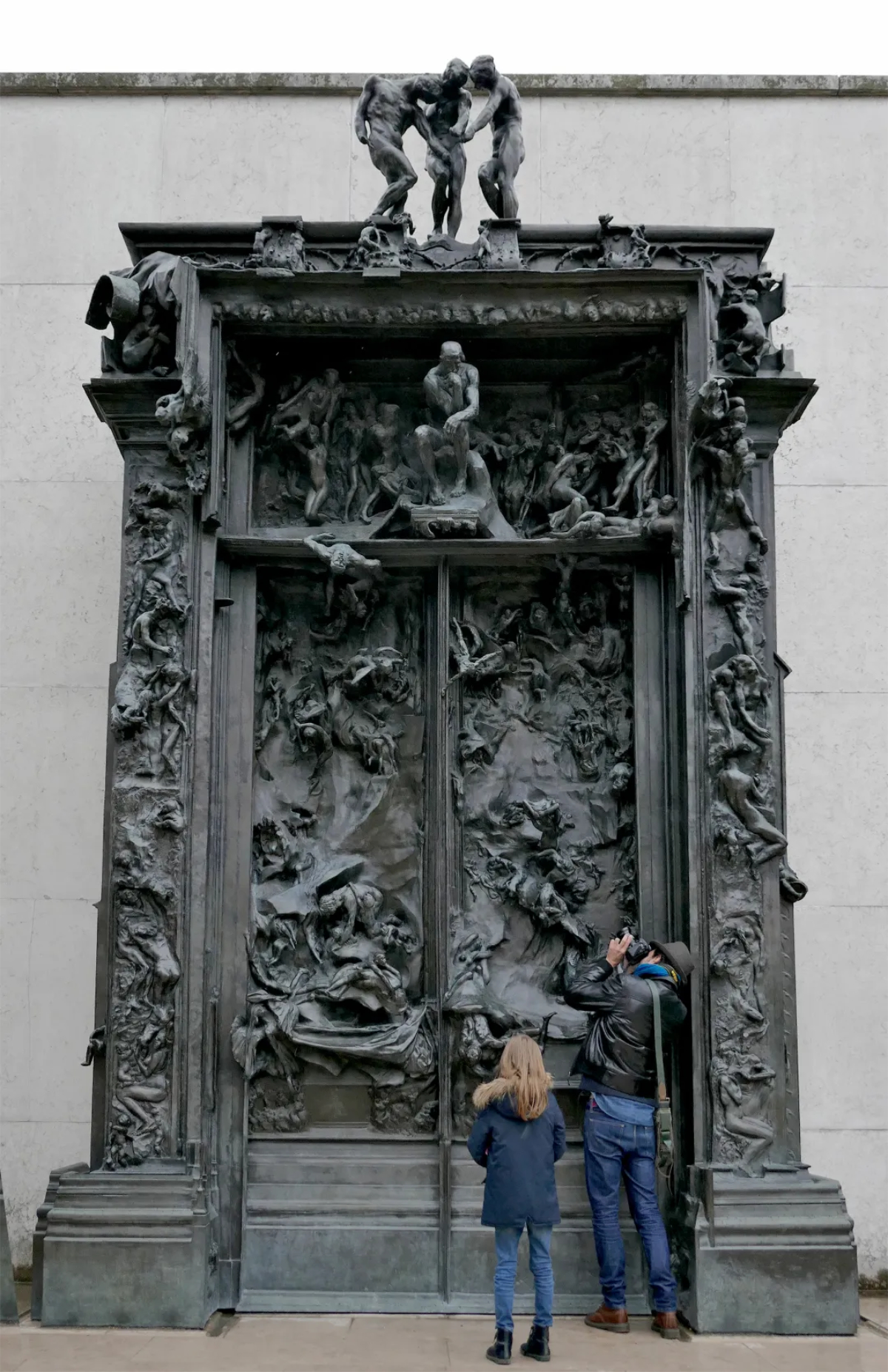
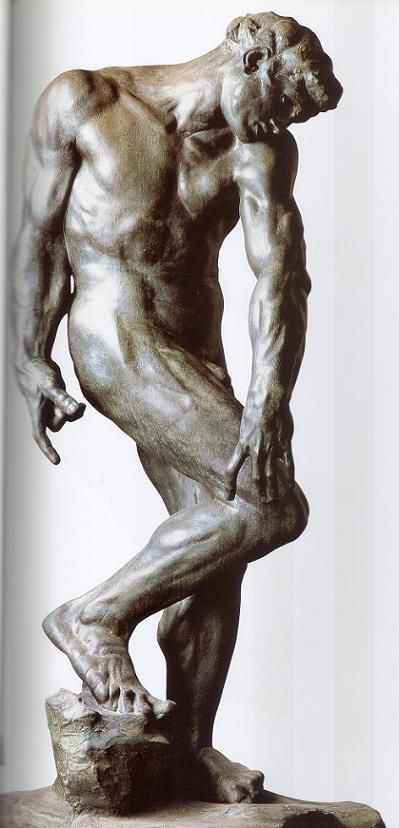
Auguste Rodin (1840-1917) once sculpted a lone standing figure of Adam coming up out of the earth. Rodin first called the work “The Creation of Man” (1880). It was later called “Adam” and intended to be a companion piece to Rodin’s “Eve,” and placed before Rodin’s long-planned, endlessly arranged and rearranged masterwork called, in allusion to Dante’s “Divine Comedy, “The Gates of Hell“ (1880-1917). Rodin worked on his “Gates of Hell” for most of his life and died before completing them. Sometimes, for creatures as much as for the Creator, creation is an ongoing process.
Rodin gave his Adam the right arm of Michelangelo’s Jesus, the new Adam, from the 1498 “Pieta” in St. Peter’s in Rome. Rodin gave his Adam the left arm of Michelangelo’s Adam reaching out to the Creator for the touch of life in “The Creation of Adam” on the ceiling of the Sistine Chapel. Like Caravaggio – and, indeed, like most human beings who have ever encountered Michelangelo’s works of art – Rodin was highly appreciative of and devoted to the old master.
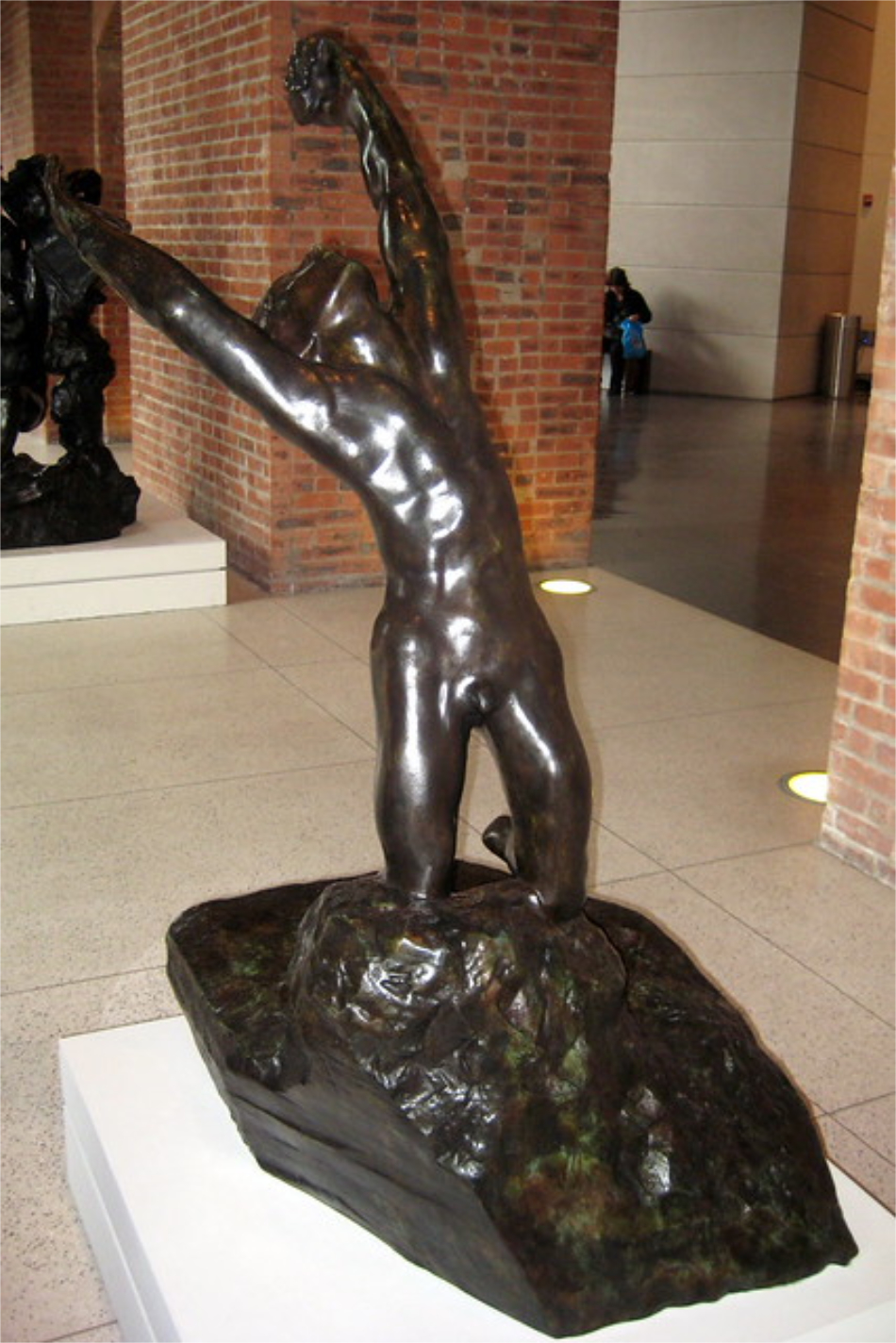
Like his “Adam,” Rodin’s “Prodigal Son” (1882) was also intended for “The Gates of Hell” but also created as a free-standing work of a wealthy Jewish landowner kneels in the filth of a pig sty, longing to fill his belly with the slops that the pigs are eating, but nobody offers him any. He has hit rock bottom and, in Jesus’ beautiful parable in the 15th chapter of Luke’s Gospel, the prodigal son finally comes to his senses. Rodin captures this one wonderful moment, a moment of both degradation and redemption. The boy’s arms are raised in agony and in determination. His body is a living scream, a terrible howl: “Yes, I shall arise and return to my father.”
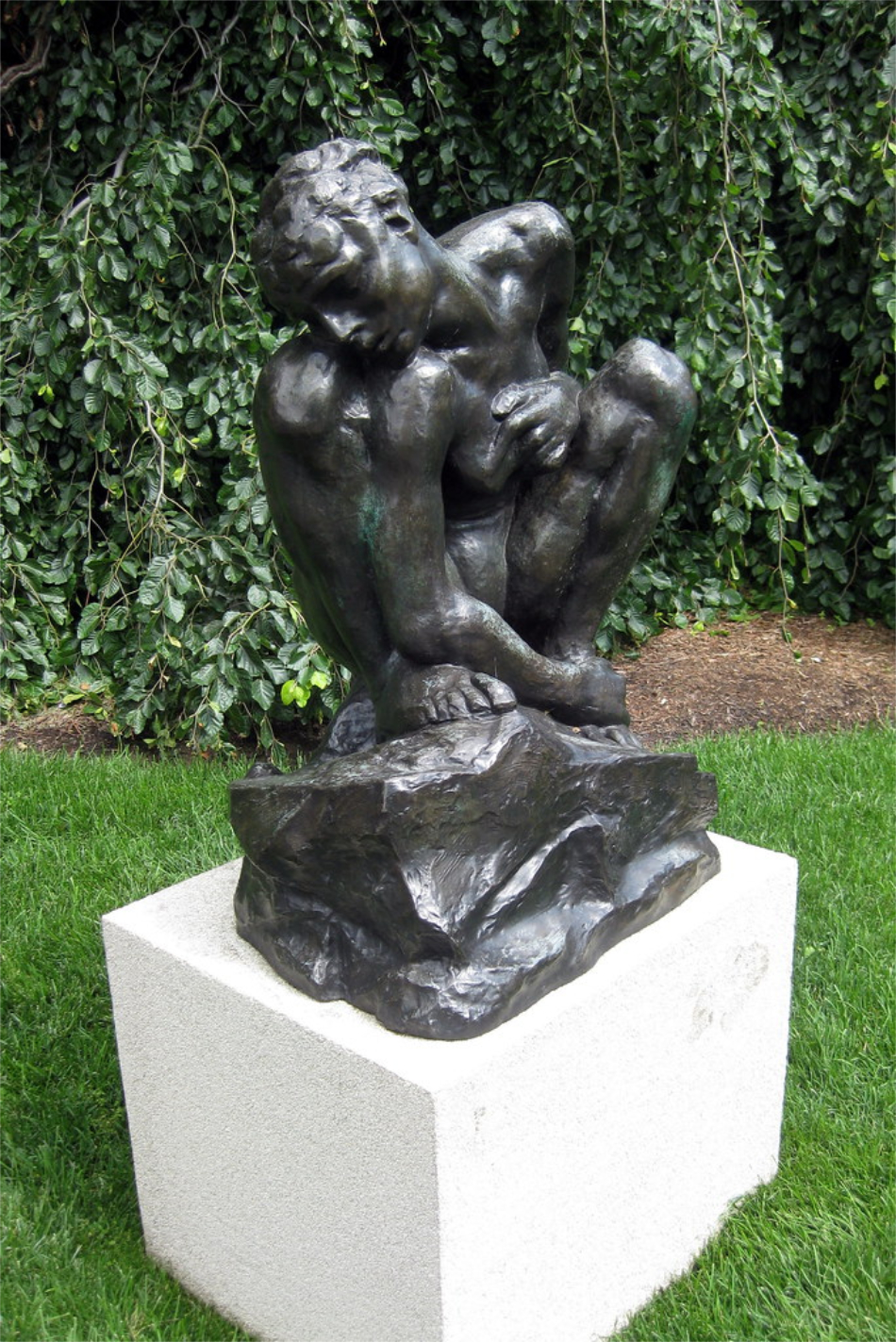
The “Crouching Woman” (1880-1882) is, again, both an independent statue and a component of “The Gates of Hell.” Rodin’s “Crouching Woman” might be in the same crushed position in which his “Prodigal Son” found himself only moments before he woke up and screamed. But will this woman ever scream? No human body could be bent down lower under any weight than the burden which this woman seems to bear. Will she ever be able to rise? She is down so low that her right shoulder is below her right knee. Her head, high on her long-stretched neck, is tilted back to the right and rests upon that knee. Her right arm is long and loose and reaches across the base to clutch her left foot. Her left hand gently touches her right breast. Only something in the tilt of her head and the vacant look on her face gives us any reason for optimism at all, any hope for her survival.
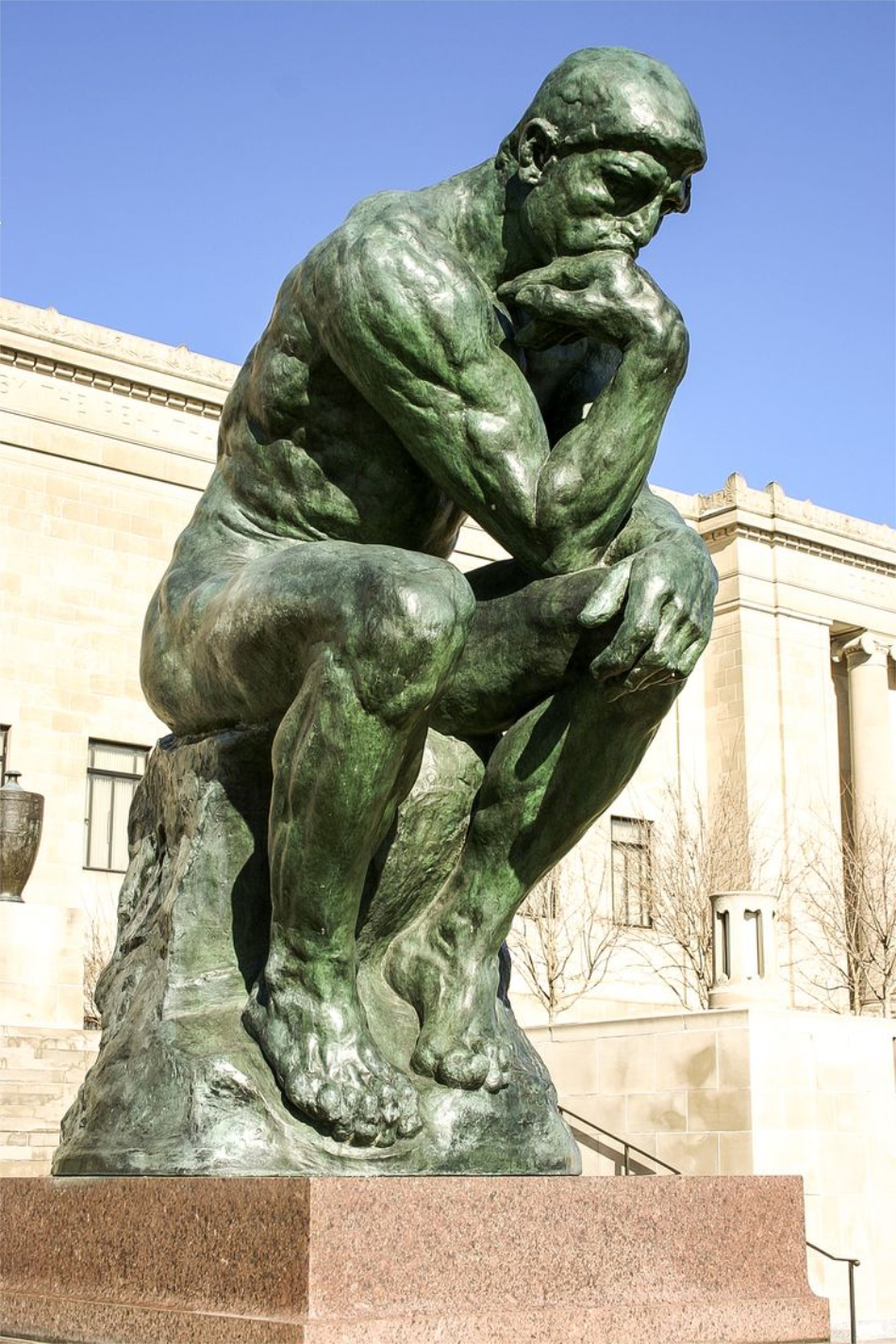
Rodin’s most famous work, “The Thinker,” was intended to be Dante musing over the happenings in his “Divine Comedy” as represented on Rodin’s great “Gates of Hell.” It also exists as a separate, free-standing statue. As such, it might reasonably remind us of any human being lost in thought. The thinker could be primitive man pondering painting pictures of animals in his cave. The thinker could be Mozart pondering his unfinished “Requiem” or Michelangelo pondering his unfinished “Pieta.” The thinker could be Dante or Rodin himself. The thinker could be you or me. We wonder. Creation is such an ongoing process.
Rodin created “Le Main de Dieu… The Hand of God” around 1898, a full four hundred years after Michelangelo’s “Pieta” in St. Peter’s in Rome. The work is carved in white marble. Like the finishes Michelangelo used for his marble statues of slaves emerging from imprisoning stone, the marble in “The Hand of God” is polished in some places and rough-hewn in others. God’s creation is an ongoing process.
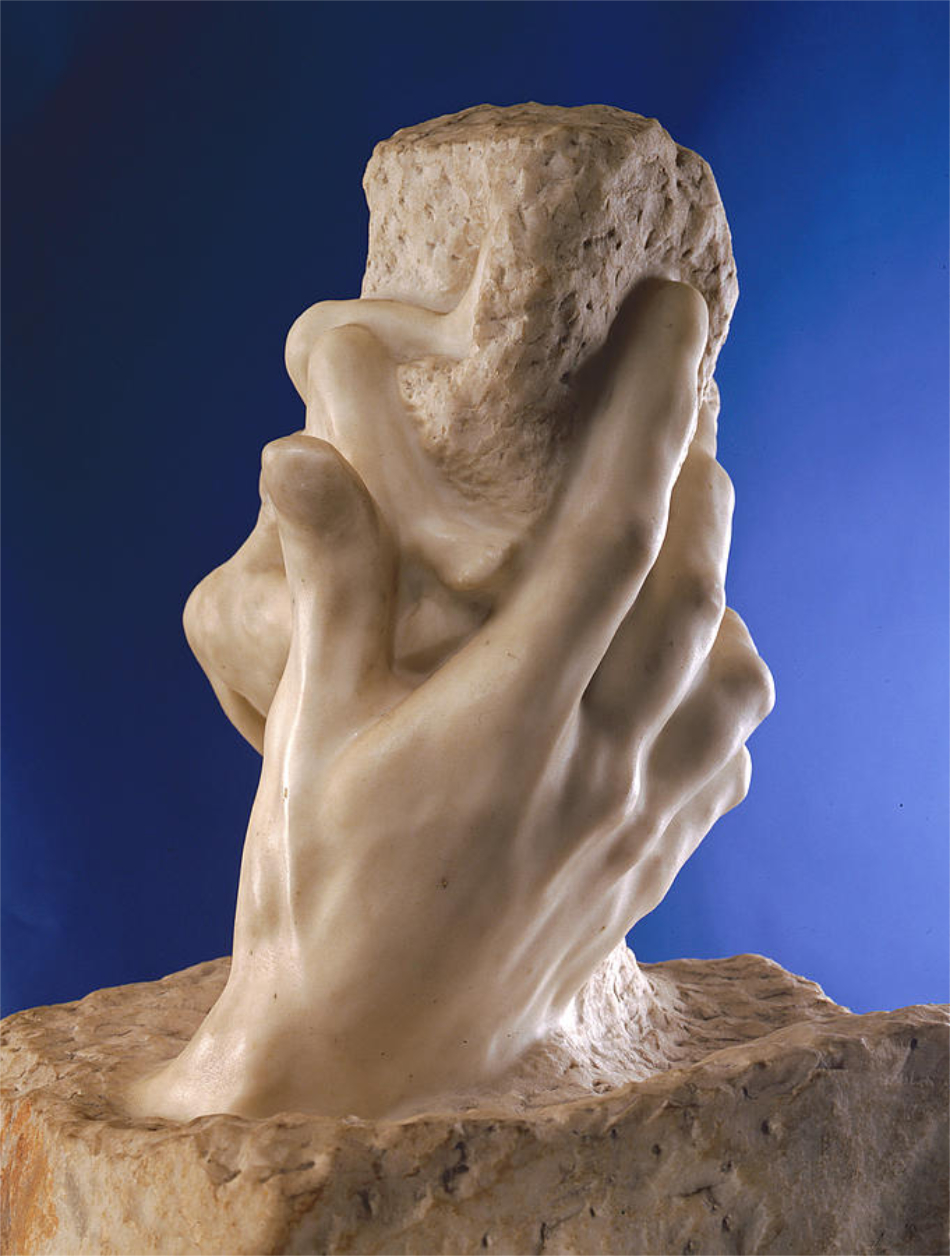
God’s strong right hand emerges from rough-hewn matter below. God’s hand is polished and has what Rodin calls “a sculptor’s thumb.” The hand is strong and muscular and smooth and uplifted. It holds a block of rough-hewn rock upon which we discover – and out of which there emerges – an embracing man and woman. They could be the first man and woman. They could be Adam and Eve. They could be any man and woman in love.
The two bodies are locked in love in the hand of God who is Love. The man’s legs are up to our right, near God’s thumb. His knees are raised. He reclines on his back with his head moving gently down to the woman’s lap, but at this moment in time, suspended by the woman’s left breast. He nestles the woman as she nestles him. His two hands embrace the top of her head. Her knees are also raised, and her two feet move off to our left. Man and woman make cradles of their bodies in order to hold each other intimately.
Man and woman are made for love. They are made for making love. And their love-making is, somehow, both a beginning and a conclusion. God who is Love has created human beings in God’s own image and likeness; male and female, God created them. God’s love and God’s love-making is, somehow, both a beginning and a conclusion. Creation is, somehow, both a beginning and a conclusion. Creation is somehow an ongoing process.
We are God’s works of art, created in the image and likeness of God who is Love. God lives and loves in us and through us. God is revealed in us and through us. God is revealed in the works of art human beings are. And God is revealed in and through the works of art human beings create.
The sacred is, mysteriously, in music and art.
God is, compassionately, in the gentle wind.