A MEDIEVAL PIETA: GOD AS MAN AND MAN AS CHILD
Most of us expect artistic depictions of people and objects to be representational. We expect the completed art-work to look a lot like the model. We are usually disappointed, confused or amused when the completed art-work does not. There is a funny scene in an old movie where the painter keeps holding up his right thumb to the beautiful model whose portrait he is painting. Over and over again, he holds up his thumb to ascertain that the proportions are accurate, that the portrait will be drawn to scale. When we finally see the portrait, the audience roars with laughter because what we see is so unexpected, so stupid. The painter has produced an oil-on-canvas image not of the beautiful model, but of his own right thumb!
Some modern art can surprise us in a similar way if we do not appreciate what the modern artist is trying to accomplish within the style of impressionism, expressionism or abstractionism, to mention a few examples. Modern artists are not playing games like the artist in the old movie. They are depicting reality not representationally, but from a different perspective, in a different way. And this really should not surprise us because we have already seen something similar happening in Paleolithic caves and Egyptian tombs, and we are about to see it happening again in medieval monasteries and cathedrals.
The cave artist obviously did not ask a wild ox to pose in the back of a dark cave and then struggle assiduously to get the anatomical proportions right, working diligently in the dim, flickering light coming from a makeshift wick stuck into a dugout stone jar filled with animal fat. More than painting representationally, the cave artist was painting symbolically. The cave artist’s painting captured a wild ox on the wall in a mysterious, spiritual effort to control the animal, to own the animal, to be better prepared to capture the wild ox in the valley. This is something other than strictly representational art.
The Egyptian artist painted many objects on the walls of the tomb, but painted each object in its own most clearly recognizable perspective. Consequently, we find many different perspectives in one painting. The artist could have opted to paint everything in the picture from one perspective as the eye normally sees reality. The artist could have painted representationally but chose not to. Why? Because these objects were not simply pictures on the wall; they were things for the pharaoh to have with him in his afterlife. The Egyptian artist was painting symbolically, spiritually, mystically. This too is something other than strictly representational art.
And so is medieval art. The medieval artist carves a statue of the Madonna and Child. We look at the finished work and are surprised that the Child Jesus looks not like a child at all but like a little man. The medieval artist carves a Pieta, a statue of the Mother of Jesus holding her crucified son’s dead body in her arms. We look at the finished work and are surprised that the dead Christ looks like a bearded dwarf. In any age, it would be a difficult task to create a graceful work of art in which the dead weight of a six-foot tall male corpse is to be placed in the arms of a five-foot tall woman. The medieval artist’s solution to the problem may strike us as childishly simplistic, just as Michelangelo’s solution (which we will soon examine) may strike us as amazingly ingenious. And, indeed, it is. But Michelangelo’s ingenious solution is one which medieval artists would not even encounter in their dreams, let alone their minds or their hands.
It has often been said that people in the middle ages related to God as young children in a God-centered world and that people in the time of the Renaissance related to God as young adult children with minds of their own in a human-centered world. The medieval artist was as delighted as a child at Christmas that God who made the sun and moon and stars had become human, had become one of us, had become a little baby. And then the medieval artist went on to depict that God-become-human-child as an adult, as a little man, as Wisdom Incarnate seated upon the lap of the Seat of Wisdom, Mary the Virgin Mother of God.
We look, for example, at the Enthroned Virgin and Child from Autun, France. It was carved around the years 1130-1140. And it was carved, with the exception of the child’s head, from a single piece of birch wood. There are still some traces of polychrome paints remaining on it. We can see, for example, that the Virgin was dressed in green.
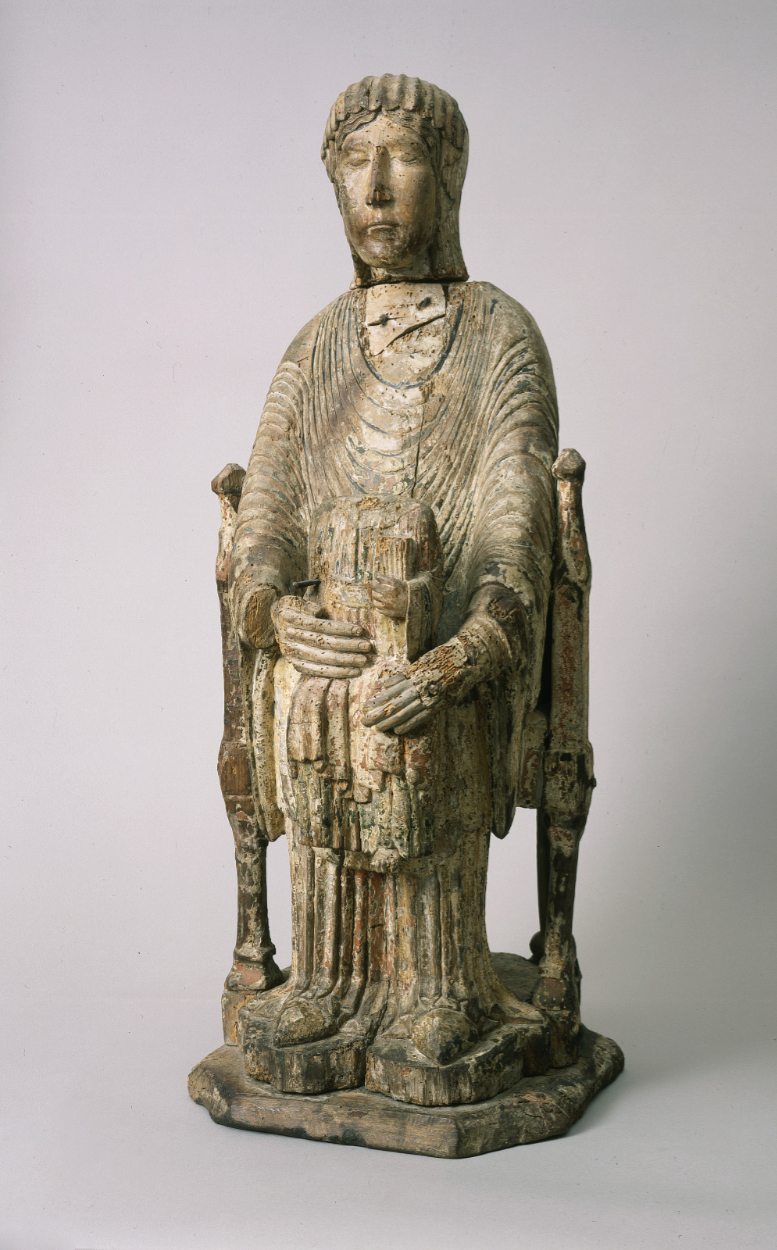
But the head of the Christ Child is missing. The head had been carved from a separate piece of wood and attached to the body with a wooden dowel. The child’s body is thin and tall and stiff.. It is not the body of a child at all. It is the body of a little man. It is the body of Incarnate Wisdom who holds a sacred book in his left hand and whose right hand is raised in mature blessing. He is a child but he is depicted, with anatomical rigidity, as a man.
The Virgin’s body is also stiff as a column and the lines carved into her robe and mantle and veil are more reminiscent of architectural lines than the natural foldings of fabric.
Her hands hold her child protectively but they seem, to the modern eye, large and unnaturally inflexible. Her face, however, is filled with feeling. She looks painfully pensive and sad. Hers is a sorrow we shall explore more deeply when we study Michelangelo’s Bruges Madonna.
But first, let us look more closely at a medieval Pieta. Our example was carved from poplar wood and polychromed and gilded in the Valley of the Rhine, Germany, around the years 1370-1400. We are immediately struck by the appearance of the dead Jesus. His arms look like spindles. His legs look like little tree trunks. His ankles are non-existent. His ribcage is just a series of parallel lines. But what is most astounding to us is that he looks like an adult shrunken to child’s size. He is all out of proportion to his mother who sits stiffly erect with slightly bowed head and feeling expression. He is still her child. He is a man but he is a child
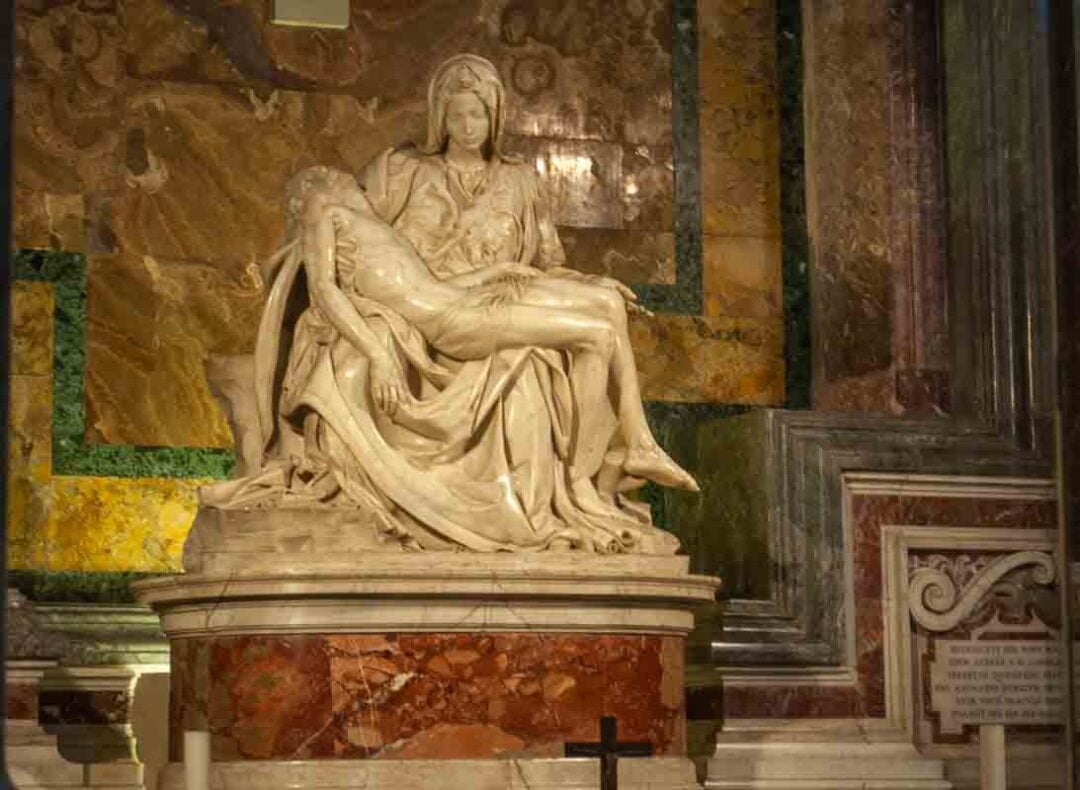
The medieval artists did not have the knowledge of human anatomy that the great Renaissance artists would glory in. They had neither the knowledge nor, more importantly, even a felt need for the knowledge. That is important for us to remember but hard for us to appreciate. We look at Michelangelo’s first Pieta and delight in its perfection. What an intelligent use of scale! What a knowledgeable presentation of human anatomy! We want to compare the medieval Pieta to Michelangelo’s and find the earlier work crude and clumsy and childish in the comparison. But, while it is helpful to notice differences, it is not at all reasonable to make evaluative and judgmental comparisons for Pietas from two different periods of history. Each work must be judged according to the standards of its own time. Indeed , every work of art must always be judged according to the standards of its own time. Otherwise, we might as well compare lilacs to roses.
The medieval artist is not saying to us, “Look. This is what Mary and Jesus looked like soon after she gave him birth. And this is what they looked like when he was taken down from the cross and placed in her arms.” Rather the medieval artist is contemplating – and inviting us to contemplate – two very real people who are very much a part of lives right now. The medieval artist is inviting us to rejoice at how very much we are loved by God – and by Jesus and Mary.
We can hear medieval chant singing in our hearts as we gaze at the Madonna and Child, “God so loved the world that he gave his only son and his son so loved us that he gave his life for our salvation …. Glory to God in the highest and peace to God’s people on earth.”
We can hear medieval chant singing in our hearts as we examine the Pieta, “Christ became obedient for us even unto death, even unto death on a cross. And because of this, God has exalted him and given him a name which is above every name.”
The medieval artist has created art which is something other than strictly representational. The medieval artist has created art which, with all of its anatomical inaccuracies, was always intended to be more than representational. It is art which, like the paintings discovered in Paleolithic caves and Egyptian tombs, has a deeply spiritual reason for existing. It is art which communicates not eye to eye – but soul to soul.
At the entrance of the Paleolithic cave, at the entrance of the Egyptian tomb, at the entrance of the medieval monastery, God is in the gentle, whispering wind