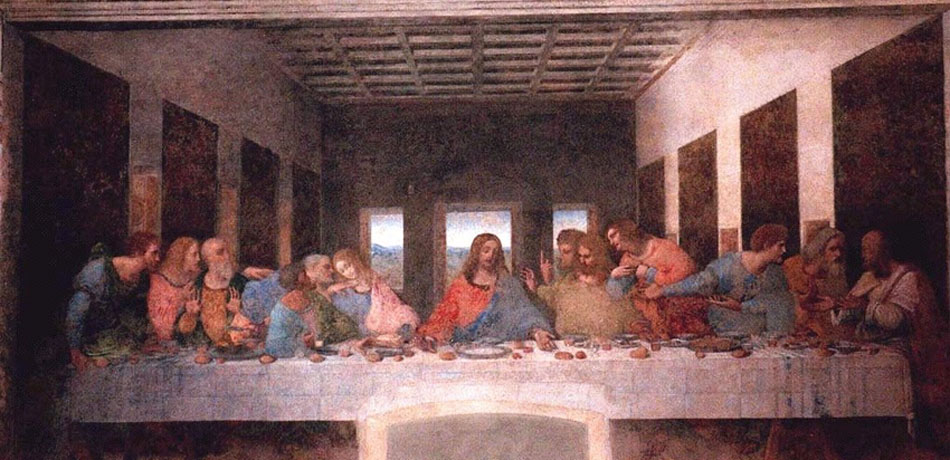
Whatever we discover in Leonardo da Vinci’s “Last Supper” is there; we can be sure, because Leonardo wanted it to be there. This great Renaissance Man is revealed in the details of his work. And there is, in fact, a whole world for us to discover in this tragically failed masterpiece. It is a masterpiece because no one but Leonardo could have painted it. It is a failed masterpiece because, even before it was completed in 1497-1498, the layers of paint began to crack, the work began to fall apart.
Giotto, we saw, painted true frescoes in the Arena Chapel in Padua. Michelangelo, we saw, painted true frescoes in the Sistine Chapel in Rome. To paint in true fresco style, an artist has to be willing to work on only a very limited section of his painting at one time and complete it rather quickly before the wet plaster dries. We can see Michelangelo placing his preliminary drawing (cartoon) on the wet plaster, poking holes around the outlines, hitting a charcoal bag against the perforations, removing the drawing, and painting quickly right into the wet plaster. Paint and plaster will dry together and give the work greater permanency. This is how the “Creation of Adam” was created.
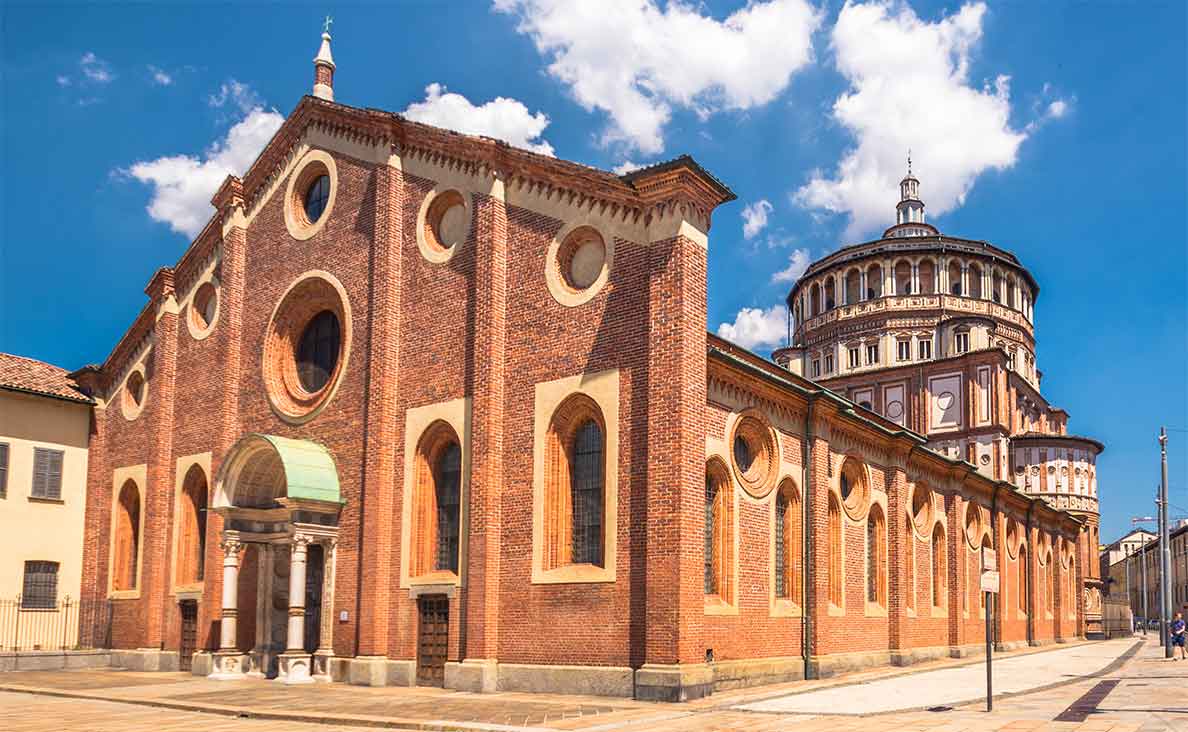
Leonardo did not have the patience to paint this way. He found it much too limiting and restricting. So the great inventor simply invented a new way to paint his huge mural of the “Last Supper. He prepared the wall in the refectory of the monastery of Santa Maria delle Grazie with several foundation layers upon which he would paint with oils. Leonardo wanted to paint when the light was exactly the way he wanted it and when the spirit moved him. Some days he would paint a great deal. Some days he would paint a single brush stroke. Many days he would paint nothing. But he was always thinking.
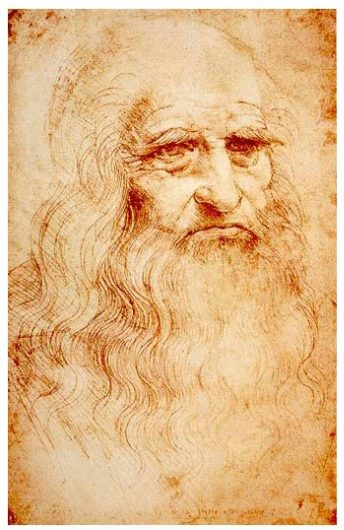
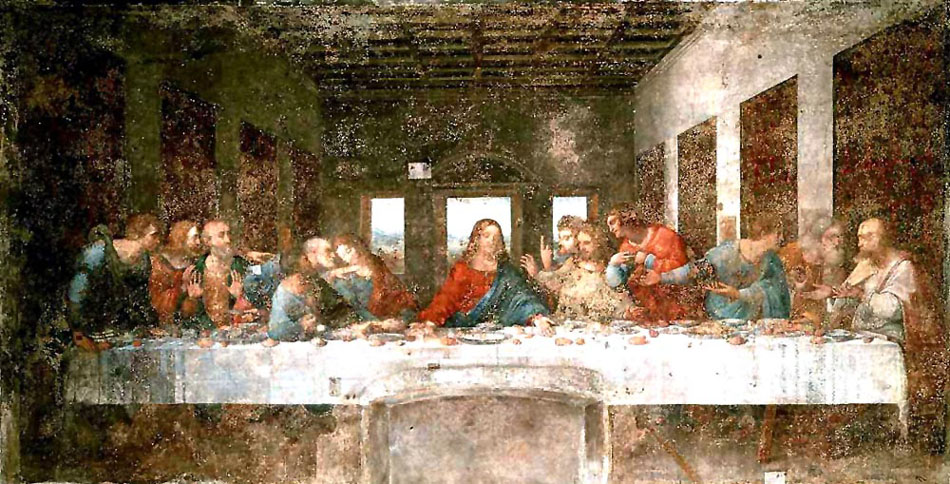
The monks who were anxious to get their dining room back wanted Master Leonardo to paint more and think less. But finally, after three years, the monks saw the completed work. And it was a masterpiece. Leonardo saw incipient cracks in the surface paint and knew that his newly invented method was not going to work, that his masterpiece would eventually flake away. And it has. Restoration has helped. (Ed. note: see original work and then restored work) But we can never see what Leonardo once saw. Unfortunately, copies painted by other artists before the deterioration went too far to help us know more about what the original painting looked like.
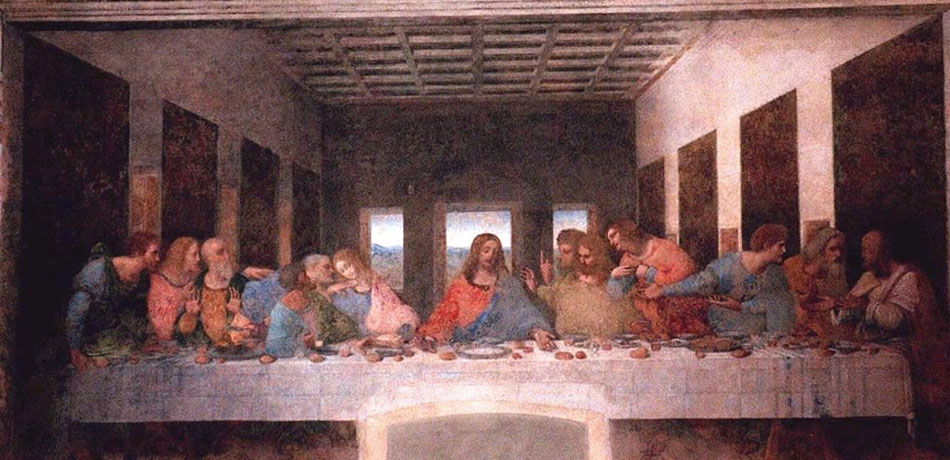
What we do see, nevertheless, is magnificent. It is the work of a Renaissance genius who, at this time of his life especially, felt very much alone. In his loneliness, Leonardo identified with the pain of Jesus who, though surrounded by his chosen twelve, is so very much alone. John, the beloved disciple, who rests his head on the heart of Jesus at the Last Supper in painting after painting after painting, does not do so here.
Jesus is alone. It is the night before he will be arrested and tortured, subjected to mock trial and crucified. He shares a Passover meal with his disciples. and he is the paschal lamb who will be sacrificed for the life of the community. What does this wine and unleavened bread have to do with the hunger and the sorrow and the captivity of his sisters and brothers? Jesus wonders. And, suddenly, in his heart, he knows that the answer is: Everything. “Take this bread and eat it,” Jesus says, “This is my body which will be given up for you”. Then he gives his friends the cup of wine and says, “Take this all of you and drink from it. This is the cup of my blood, the blood of the new and everlasting covenant. It will be shed for you and for all so that sins may be forgiven.” Then Jesus looks at his disciples, loving them till the end, and says, “Do this in memory of me.”
Jesus, in Leonardo’s depiction of this great Gospel event, is alone as the center of a very long table. His two hands are outstretched over the bread and wine. Leo Steinberg, in his excellent essay, “The Seven Functions of the Hands of Christ: Aspects of Leonardo’s Last Supper” (“Art, Creativity, and the Sacred” Edited by Diane Apostolos Cappodona, Crossroad, New York, 1986) reminds us that the way Leonardo has Jesus stretch out his hands necessarily lowers the Lord’s shoulders and, in so doing, reveals his vulnerability, his humanity, his resignation. At the same time, his hands outstretched at the angles in which Leonardo has painted them make the head and upper torso of Jesus – all that is visible above the table line form a definite triangle, the Christian symbol for the Trinity, and thus Leonardo reminds us of the divinity of Jesus. “The Father and I are one …. I AM the Resurrection and the Life …. I AM the way and the truth and the life I AM.”
But at this moment, Jesus is sadly, strangely, terribly alone. All twelve apostles are at table with him. This could be a time for celebration. There is an old Communion Song that sings with delight, “God and Man at Table Are Sat Down,” rejoicing that, in Jesus, we are reunited with the God who created us. This Last Supper could be a time for celebration. But, for Leonardo, Jesus is alone. Leonardo has depicted all twelve apostles on the same far side of the table as Jesus. But Jesus is alone. Six men are positioned on his right, which is the darker side of the painting and six on his left, which is the brighter side of the painting. And Jesus is alone. The disciples are all individuated characters but are arranged symmetrically in groups of three. And Jesus is alone.
The three disciples closest to Jesus on his right, the darker side of the painting, are the three disciples most involved in the Passion narrative. We see Peter, who will this night three times deny that he even knows Jesus. Peter is holding a knife with which he will sever the ear of Malthus, the high priest’s servant, in the Garden of Gethsemane when Jesus is arrested. Next to Peter is John, who, alone among all the twelve, will stand beneath the cross of Jesus and will take the Mother of Jesus as his own. Next to John, lowest in position in the entire painting, is Judas who will betray his master with a kiss. Judas, the treasurer of the little group, holds a bag of money. This is the Passion and Death side of the painting.
Among the three apostles closest to Jesus on his left, the brighter side of the painting, we see Thomas whose index finger is raised high, reminding us of what will happen after Thomas has doubted the Resurrection of the Lord. Jesus will appear to his disciples again and say to Thomas, “Take your finger and place it in the place of the nails in my hands. Take your hand and place it in the place of the spear in my side. And be not unbelieving but believing. Thomas will respond, “My Lord and my God.” And Jesus will say, for Thomas and for us, “Because you have seen me, Thomas, you have believed. Blessed are they who have not seen and have believed.” Next to Thomas is Nathanael, highest in position in the entire painting, “an Israelite. Jesus called him, “in whom there is no guile.” “Are you so surprised because I said I saw you under a fig tree?” Jesus asked him when they first met and then promised him, “You will see far greater things than this. You will see the angels of heaven descending upon the son of man.” This is the Resurrection side of the painting.
The left hand of Jesus on this side of the painting, Steinberg reminds us, points to the tombs below where monks are buried in the monastery crypt, disciples who share the risen life of their Lord, Jesus. The left hand of Jesus also points to a little loaf of bread on the table, reminding us of Jesus’ promise, “I am the bread of life. You who eat this bread will never die.” The left hand of Jesus also opens in welome, reminding us of Jesus’ promise, “Come, you blessed, into the kingdom prepared for you since the beginning of time, for I was hungry and you gave me to eat. I was thirsty, and you gave me to drink… ”
The right hand of Jesus, however, on the dark side of the painting, accuses Judas, “Can one of you who dip into the dish with me betray me?” The right hand of Jesus indicates the cup of wine, “This is the cup of my blood, the blood of the new and everlasting covenant, my blood poured out for you”. And the right hand of Jesus points in condemnation at the Last Judgment, “Go, you damned, into the fires prepared for the devil and his angels, for I was hungry and you gave me nothing to eat. I was thirsty and you gave me nothing to drink ….” Finally, Steinberg observes, both hands of Jesus appear to be open in a warm, welcoming embrace to the viewer who walks into the refectory of Santa Maria della Grazie in Milan.
Copies of Leonardo’s “Last Supper,” made while the painting was still in good condition, reveal floor boards below the table that point in on Jesus. In fact, the two feet of Jesus are placed on top of one another on the central board in a way unusual for a man seated at table but eerily reminiscent of the way the feet of the crucified savior had been placed upon the board of the cross. Floor boards, ceiling cubes, the two walls on either side of the table, all converge to a vanishing point in some infinite place behind the head of Jesus.
The precision, the perfection of this great masterpiece by the Renaissance Man par excellence, Leonardo daVinci, was hurt by more than time and a faulty new mural technique. Monks carved a door through the bottom center of the mural in order to get hot food more quickly and more warmly from the kitchen to the dining room. Napoleon stored his horses there in the refectory during his invasion. World War II bombers destroyed the monastery, leaving only one wall standing. It was the wall upon which Leonardo daVinci had painted the “Last Supper.”
We can ponder its beauty and unravel its mysteries still.
For, somehow, God continues to communicate through a gentle, whispering wind