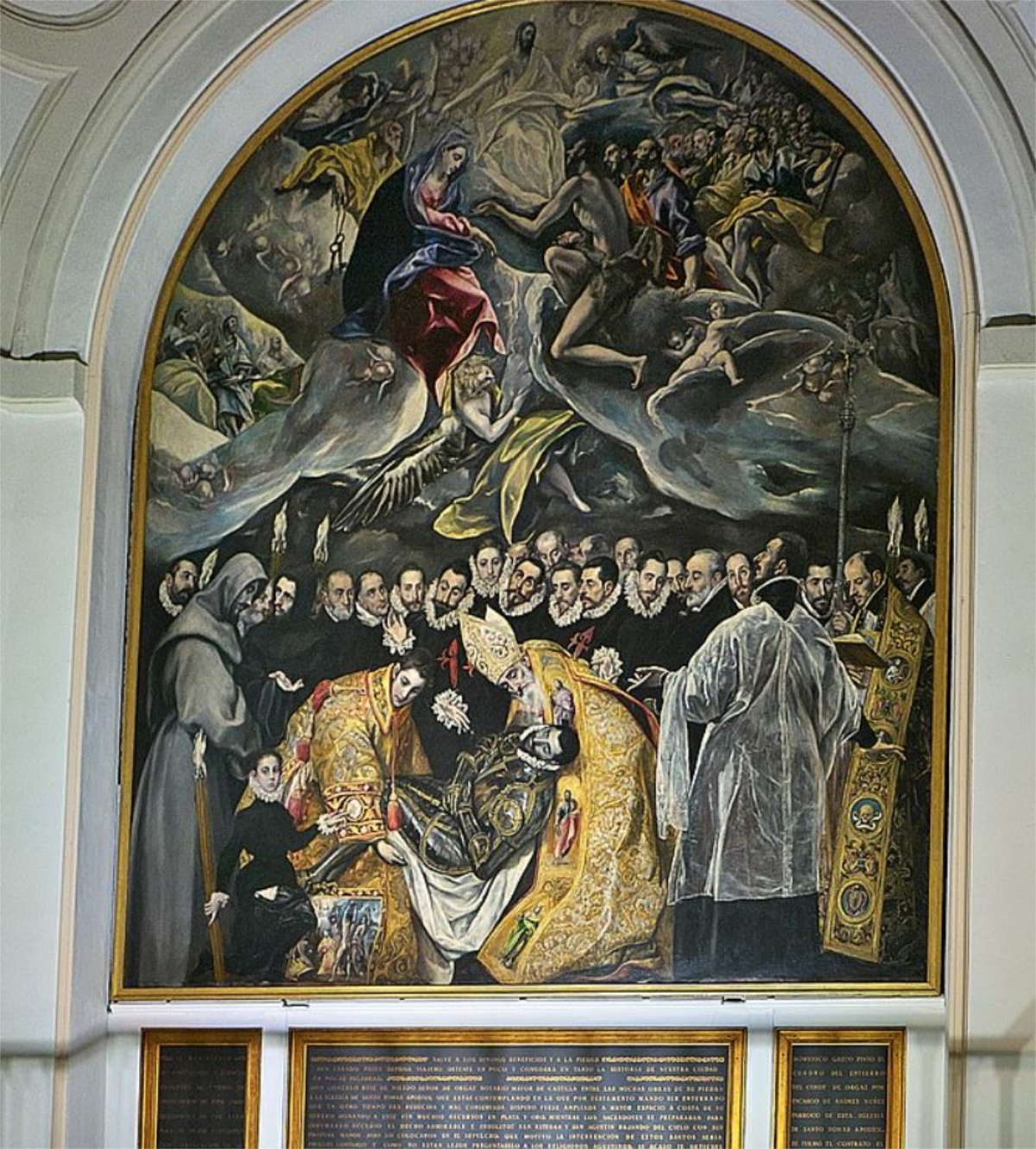
The figures in the upper half of the painting are strangely elongated, stretched higher and higher and, somehow, spiritualized. The figures in the lower half of the painting are not. Some critics have explained El Greco’s elongation of people in his paintings by blaming it on the artist’s astigmatism. This painting, probably his greatest masterpiece, clearly gives lie to that explanation. Here we have, in one great oil on canvas, El Greco’s “Burial of the Count of Orgaz,” a profound expression of mysticism and spirituality. This painting echoes the music of Victoria and the prayers of St. Teresa of Avila and St. John of the Cross.
It also echoes the theological understanding of the Fathers of the Council of Trent. The Protestant Reformation insisted upon the supremacy of faith over good works and argued that people are saved not because of any works they do but simply because they believe in the Lord who saves. The Catholic Counter-Reformation insisted that faith without good works was dead and argued that people who really believed in the Lord would necessarily experience their faith overflowing in loving service of their sisters and brothers in the Lord.
El Greco accepted the Catholic position. Domenikos Theotokopoulos (1541-1614) was born in Crete, studied painting in Italy and spent most of his life painting in Spain. But this was Spain during the Council of Trent and the Spanish Inquisition. These were fanatically passionate times especially in Spain. And El Greco was a Catholic.
El Greco accepted and believed in the importance of faith overflowing in good works. In fact, faith overflowing in good works is a motif woven throughout his paintings.
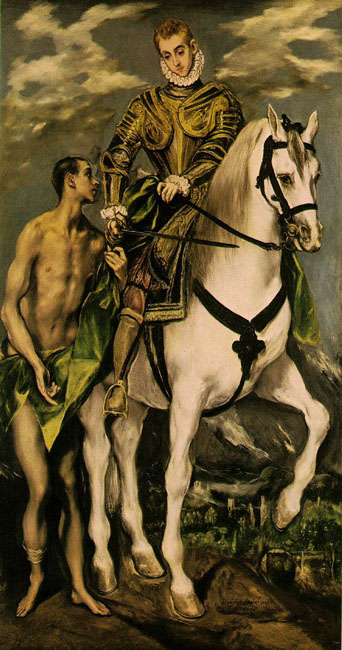
We marvel, for example, at El Greco’s “St. Martin and the Beggar” (1597-1599). Martin, a wealthy young soldier, high on horseback, is depicted cutting his luxurious green mantle in half with his military sword. The color green is symbolic of hope. There is hope for the poor, sick, naked, young beggar walking along beside Martin’s magnificent white horse. And there is hope for Martin too. Martin is about to share his clothes with the beggar. Suddenly, we notice something wonderfully surprising about the appearance of the two young men. They look like brothers. As El Greco has painted these two elongated figures, Martin and the beggar look, for all the world, like identical twins. “Come into the kingdom prepared for you from the beginning of the world, for. I was naked and you clothed me. Whenever you did it for the least of my brothers and sisters you did it for me.” Faith without good works is dead.
In no painting is this particular theme more clearly apparent than it is in the “Burial of the Count of Orgaz” (1586-1588). The Count, Don Gonzalo de Ruiz, was a good man who, in his lifetime, was very generous in caring for the poor. Now he has died and is being buried, attended in death by praying priests and ruffle-collared mourners. Because the Count was such a good man, St. Stephen and St. Augustine appear, miraculously, to lower his corpse into its resting place. And, directly above his corpse, we see the soul of the Count, in the form of a transparent, protoplasmic baby, entering heaven, accompanied and lovingly lifted up by an angel robed in gold.
In heaven, we see, on our right, a very elongated figure clad in rough camel’s hair. He is St. John the Baptist. Next to him, on our left, is Mary, the Mother of Jesus, clad in red, symbolic of love and sacrifice, and blue, symbolic of faith. Above and in-between these two figures, central in heaven, is the Risen Lord Jesus, dressed in white, symbolic of purity. The soul of the Count seems headed straight up the center of the painting, straight to Jesus. We also see St. Peter, holding the keys of the kingdom, on our left, and countless numbers of the saints in heaven, on our right. All these figures in heaven are elongated. El Greco emphasizes their spirituality and holiness.
What separates heaven and earth in the viewer’s eye is the long horizontal line of white ruffled collars cutting across the painting. The mourners are all men and all dressed in black in the contemporary style of the sixteenth century. They are depicted as contemporaries of El Greco rather than as contemporaries of the Count of Orgaz whose burial took place in 1303. And these contemporary Christians are compassionate. We see tears in their eyes and graceful delicacy in their open hands.
A priest to our right also has his hands open but not in mourning or questioning so much as in surprise. He seems to see something no one else sees. His gossamer light surplice clings to his cassock as he himself clings to earth. But he believes. And he seems to see the heavens opening above to receive the soul of the Count of Orgaz. A young boy, on our left, points with his hand to direct our attention to the miracle of St. Stephen and St. Augustine assisting in the burial. The model for the young boy was El Greco’s son, Jorge. The paper in his pocket identifies the artist in Greek cursive letters as Domenikos Theotokopoulis, Cretan and painter.
The miracle to which we are directed reveals St. Stephen and St. Augustine holding the Count’s body. St Stephen, on our left, is a handsome young man, dressed in a deacon’s gold dalmatic. A picture on his dalmatic reveals a naked Stephen as the first martyr, surrounded by men hurling rocks at him. This happened in the first century. St. Paul tells us that he himself held the cloaks of people throwing rocks at Stephen, while Stephen looked up to Jesus in heaven and prayed for forgiveness for those persecuting him. St. Augustine, wearing a heavy gold cope and bishop’s mitre, was a third century bishop of Hippo and one of the great Church Fathers. Augustine prayed, “You have made us for yourself, O Lord, and our hearts are restless until they rest in thee.”
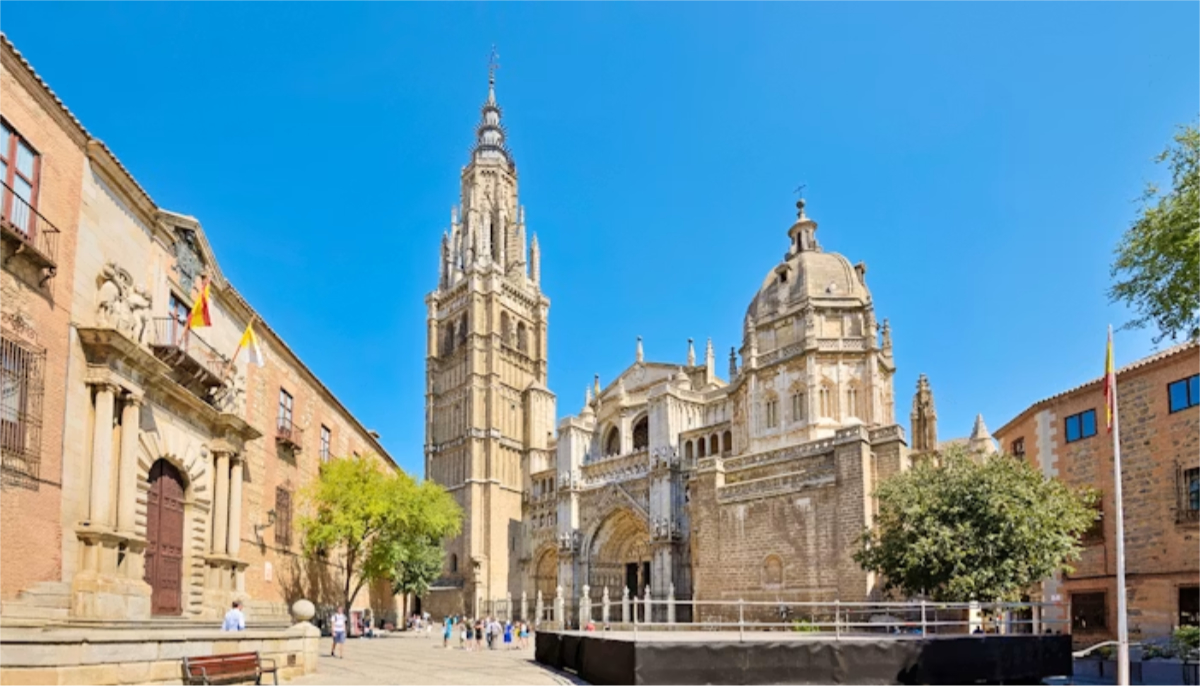
Together, Stephen and Augustine lay the Count of Orgaz to his eternal rest in Jesus. A good man receives heavenly reward for all the good works he performed on earth. The painting is in the Church of St. Tome in Toledo where the Count is actually buried. In fact, the painting is right above his tomb. Were it not for the bronze plaque placed on the wall between the painting and the tomb below, it would seem as though Stephen and Augustine were literally placing the body of the Count into his tomb.
The great mystic poet William Blake reminds us that you can “see a world in a grain of sand,/ And a heaven in a wild flower,/ Hold infinity in the palm of your hand,/ And eternity in an hour.” El Greco’s “Burial of the Count of Orgaz” enables us to do just that. It is, as a matter of fact, the only painting El Greco painted for a public place. And it is his masterpiece, there for all the world to experience. We can hold “eternity in an hour” as God moves in a gentle, whispering wind over a tomb in Toledo.