The very opening of Mozart’s “Requiem” K 626 reveals the Classical, religious, personal, eighteenth-century, Christian-humanist that Wolfgang Amadeus Mozart (1756-1791) was a child of the Encyclopedists who proudly proclaimed humankind’s Enlightenment. Human reason is supreme. Balance, order, proportion, symmetry are the ideals. The Classical Era is a Re-Renaissance. The world is a universal cosmopolis where every powder-wigged citizen even looks like every other.
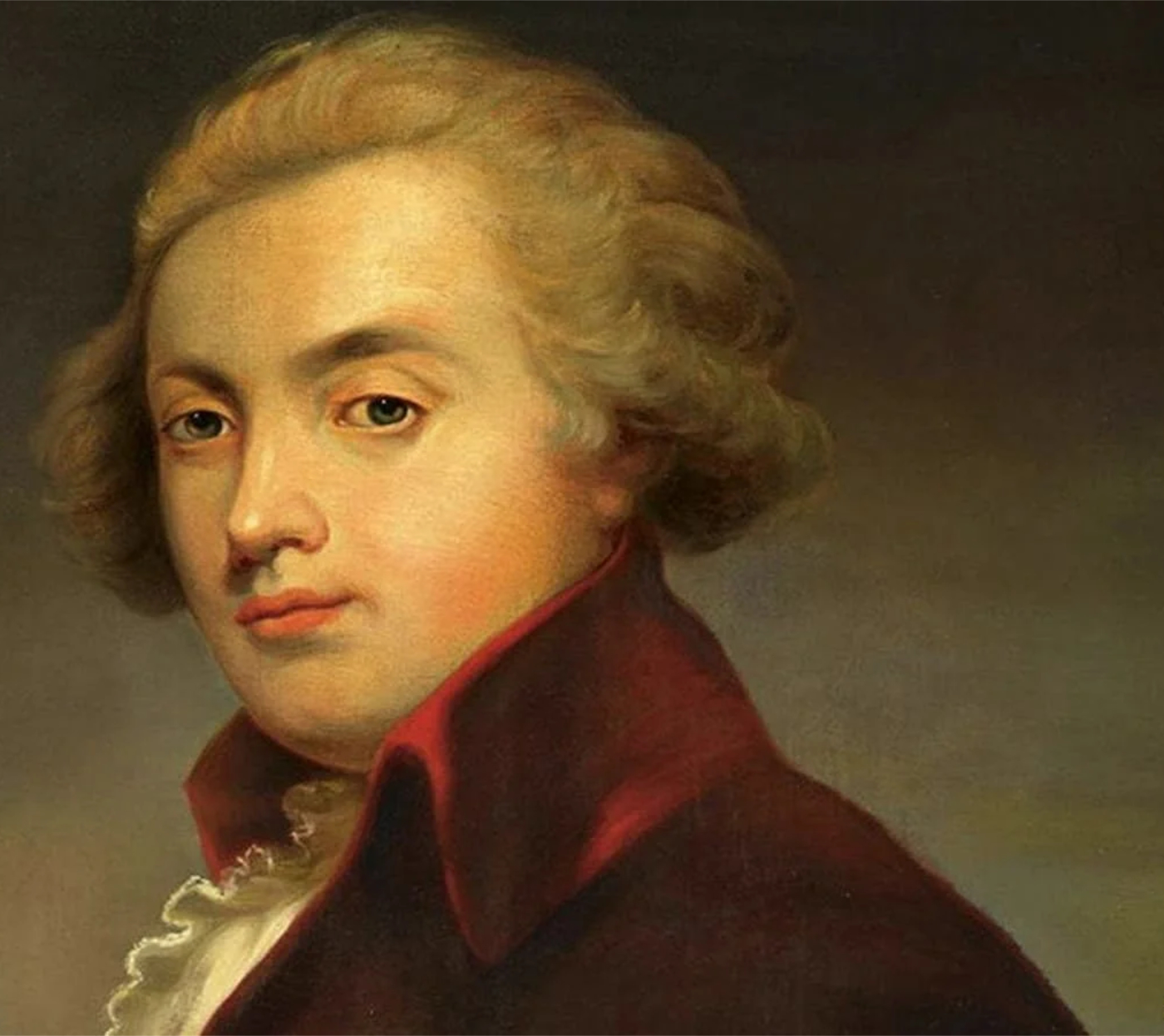
Mozart’s “Requiem (1791) is his final composition, the music he was working on when he died. It emanates, as does all his music, from a composer who was a man of his times. Mozart could not call any reality real where the secular was divorced from the sacred or where the human was sucked out of the Christian.
In the opening measures of the Introit, Mozart achieves a mournfully pounding rhythm through the alternation of eighth notes from basses and cellos to violas and violins. Sorrowful melodies enter as songs sung by pairs of bassoons and basset horns. They are a gentle wail, a tender dirge. The focus as yet is on the confusion of the bereaved rather than upon the consolation of God.
The first voices to sing the text, “Requiem aeternam dona eis, Domine. Eternal rest grant unto them, O Lord” are the basses. The dark coloration is deepened even more by having string basses and cellos double the low male voice line as well as the organ’s bass line -which Mozart does not only here, but rather consistently throughout the Introit. As violins cry in falling octaves, tenors, altos and sopranos follow quickly upon the entrance of the basses, building up the painful urgency of the prayer for rest. Trumpets and timpani which heralded the entrance of the voices rather simply, but ominously, more strongly accompany the chorus’ plea once all the voices have entered the prayer.
There is a softness at the end of “et lux perpetua luceat eis… and let perpetual light shine upon them” as the prayer begins to focus more hopefully on God. There is hope in the music that, for all the pain of the bereaved, God’s light will shine upon the deceased. A soprano soloist fills the quiet expectancy of this moment with the psalmist’s insistence that it it right for God’s people to pray to God Mozart uses a chant tone for this psalm verse, “Te decet hymnus, Deus, in Sion_ A hymn is fitting for you, O God, in Sion” and the focus is more certainly fixed on God Strings flow almost sweetly.
But, then, “exaudi orationem meam … hear my prayer.” With the sopranos repeating the chant tone of the “Te decet,” the chorus prays more forcefully. They are accompanied by a perturbed, repeated rhythmic figure which is even more urgent and agitated than the rhythm at the opening of the Introit.
There is enormous pain in death. There is faith, yes, but there is mystery and confusion and pain. Mozart, the Classicist is foremost Mozart the human being. He speaks to the rationalist world of his time – and ours – with musical logic and form but also and most fundamentally with human emotion expressed in musical refinement.
The Christian-humanist in Mozart, moreover, believes that there is more than human pain in death; there is also hope, for there is a God who has promised eternal life to those who believe. At measure thirty-four, the octaves in the violins are not falling as they were in measure eight. They are rising. There is gentleness and tenderness and hope in the music.
As the basses begin to repeat, “Requiem aeternam…” darkly but gently, the altos begin to sing “dons eis, Domine” in a soft flowing rhythm reminiscent of the violins’ interlude in the “Te decet_” The fluidity and peace of the music here, which are in such sharp contrast to the perturbed rhythmic figures of the “exaudi,” suggest peace. They suggest the faithful confidence and trust that God will give rest. And so it is that the light of the final repetition of “et lux perpetua luceat eis and let perpetual light shine upon them” is quiet and gentle, soft, unagitated, and almost shining.
This contrast between human pain and Christian faith is maintained in the ‘Kyrie.” “Kyrie eleison… Lord have mercy…” is set to the strong and firm first fugue subject; a strong melody which will “fly” (from the Latin verb, fugare) from voice to voice. “Christe eleison… Christ have mercy…” is set to the agitated and almost impulsive second fugue subject. Unlike other Requiems we have studied, then, both invocations are sung simultaneously in Mozart’s “Requiem.”
The *Kyrie” soars with emotion to its climax, but it is highly classical in form. After the initial exposition of the subjects of the double fugue, there is development of the musical material, then recapitulation and coda. The exposition lasts from measure one to measure fifteen. Subjects appear first in the bass and alto voices and are answered in the soprano and tenor. Then subjects appear in the alto and bass voices and are answered in the tenor and soprano. Instruments underscore the voices for an even stronger urgency in Mozart’s plea that the Lord have mercy.
The double-fugue “Kyrie” shows the style of a later Mozart who had studied the sacred music of Bach and Handel. But Mozart goes beyond the old masters. Evidence of that is Mozart’s frequent modulation into what Einstein calls “the darker regions of harmony” within the development section of the fugue. The development section goes from measure sixteen to measure thirty-seven. Mozart modulates into the key of F major in measure sixteen; G minor in measure twenty; E Flat major in measure twenty-five; B Flat Major in measure twentyseven. Mozart returns to the key of D minor for the recapitulation beginning at measure thirty-seven. The brief coda, marked adagio, goes from the end of measure forty-eight to the fiftieth and last measure of the “Kyrie.”
Unfortunately, having heard the “Introit” and “Kyrie” of Mozart’s “Requiem,” we have heard the only sections of the work which were completed entirely by Mozart as far as musicologists can determine. It is quite possible that all the remaining orchestration is by Mozart’s pupil Franz Xaver Sussmayer aided, in all likelihood, by verbal instruction and probably even written sketches by Mozart. It was certainly not completed by Salieri, with Mozart dictating the score from his deathbed, as imagined in the film, “Amadeus,” although that powerful scene does capture some of the mystery and pathos of Mozart’s frustrating struggle to complete his “Requiem” before he died.
Mozart knew that he was dying as he wrote the “Requiem.” He believed that he had been poisoned. He also believed that this, his swan song, had been commissioned by an angel of death all dressed in grey. He worked feverishly to complete the work. He wrote all the parts, vocal and instrumental, for the “Introit” and “Kyrie”. Mozart wrote the rest of the vocal parts and sketched in most of the instrumental parts, leaving the rest to be completed by Sussmayer. It is difficult to trust Mozart’s wife, Constanze’s version of the story because she would have made more money – which she needed desperately – by claiming that the work was entirely completed by her husband. So a certain sense of unrest will always hover about Mozart’s “Requiem.” But what we have heard of it – the “Introit” and Kyrie – is, without doubt, all Mozart.
So is another wonderful work of sacred music which has been alluded to in the Introduction, Mozart’s “Ave verum corpus” K. 618. It was also composed in 1791, the year of Mozart’s death at the age of 35. Mozart composed this perfect pearl of musical prayer for the Feast of Corpus Christi for Anton Stoll, the local choirmaster of a little church in Baden, near Vienna. It is masterfully concise and deceptively simple, shimmeringly serene and deeply moving.
Strings, organ and SATB choir sing to Jesus in the Blessed Sacrament in the belief that the Body of Christ in the Eucharist is the Body of Christ born of Mary, the Body of Christ which suffered and died on the cross for us, the Body of Christ which rose from the dead, the Body Of Christ which is our assurance of eternal life.
Organ and strings begin tenderly before voices enter singing the text of the ancient prayer in this new Classical setting by Mozart: “Ave verum corpus natum de Maria Virgine… Hail Body truly born of the Virgin Mary.” All is gentle. All is homophonic; there is no overlapping of voices. Then “Vere passum immolatum in cruce pro homine… (Hail Body) which truly suffered and died on the cross for us.” There is a beautiful touch of polyphonic writing, a tender emphasis, on the word “cruse… cross.” The sopranos hold the first syllable while the rest of the voices come in under them in gentle support. It is a thrilling moment in music.
Organ and strings shine softly in a gentle interlude. The voices continue with greater weight, “cuius latus perforatum unda fluxit et sanguine… (Hail Body) from whose pierced side there flowed blood.” There is sympathy and gentle compassion in the music.
Then the voices move to polyphonic overlapping of the final phrase of the prayer, “Esto nobis… Esto nobis… praegustatum… praegustatum… Be for us… for us… for us… a foretaste… a foretaste (of eternal life).” The polyphonic touch here emphasizes the great number of people praying to Jesus, praying as the repentant thief crucified next to him, “Lord, remember me when you come into your kingdom.” And Jesus answered, “Amen, I say unto you that this day you will be with me in Paradise.” “Esto nobis praegustatum in mortis examine… Be for us a forestaste (of eternal life) in the trial of death.” Mozart echoes the same polyphonic touch on the word “mortis… death” as he had done on “cruce… cross.” Once again sopranos hold the first syllable high. Once again, the other voices come in gentle support.
Organ and strings rock contemplatively back and forth as we continue to pray and remember – and celebrate – and believe. This perfect musical prayer is little more than three minutes long. But it is eternal. It is an eternal, gentle, whispering wind – revealing not only Mozart’s beautiful heart, but God’s.