The Classical characteristics of symmetry, balance, proportion and form which we heard embodied in the music of Mozart we also see enfleshed in the paintings of Jacques-Louis David (1748-1826). Life and death, love and sacrifice, are all carefully delineated by David in the Classical style of realism – which is realism in an ideal world where reasonability reigns supreme.
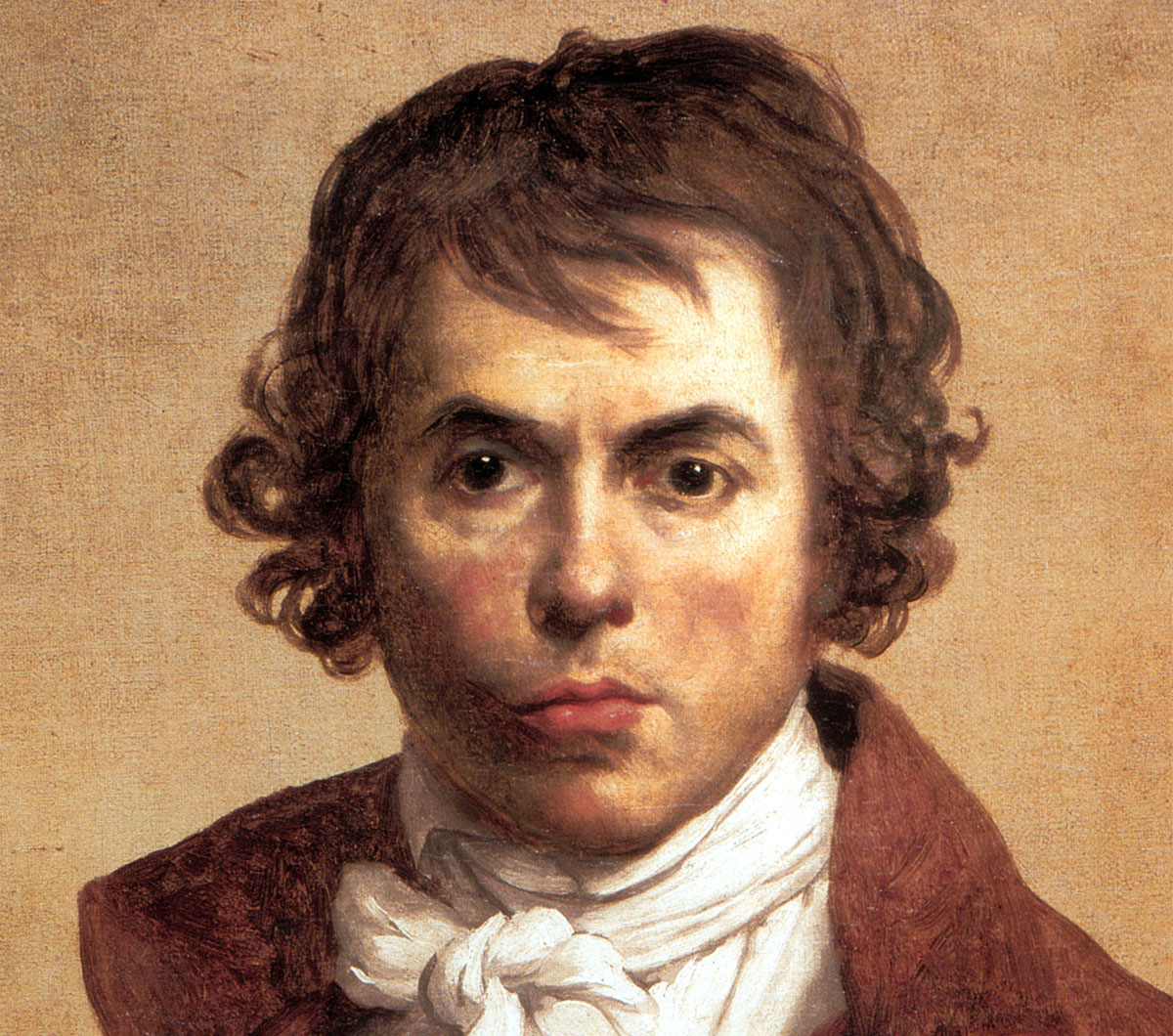
We look first at David’s “The Oath of the Horatii” (1784-85). We see three strong and mighty Roman arches in the background, emphasizing the idealism of the setting. We see three strong and mighty Roman warriors in the foreground to our left, in front of the first of the three arches. They are three brothers swearing a sacred oath to fight three Curatii warriors to defend their city. The brothers are closely embraced in their sacred mission. Their arms and legs are muscular and taut. Their heads are helmeted. Their faces are very young but determined. They are reaching out their arms towards their father, who holds three swords in his left hand. His three sons, their hands extended palms down, are swearing to use the swords nobly and well.
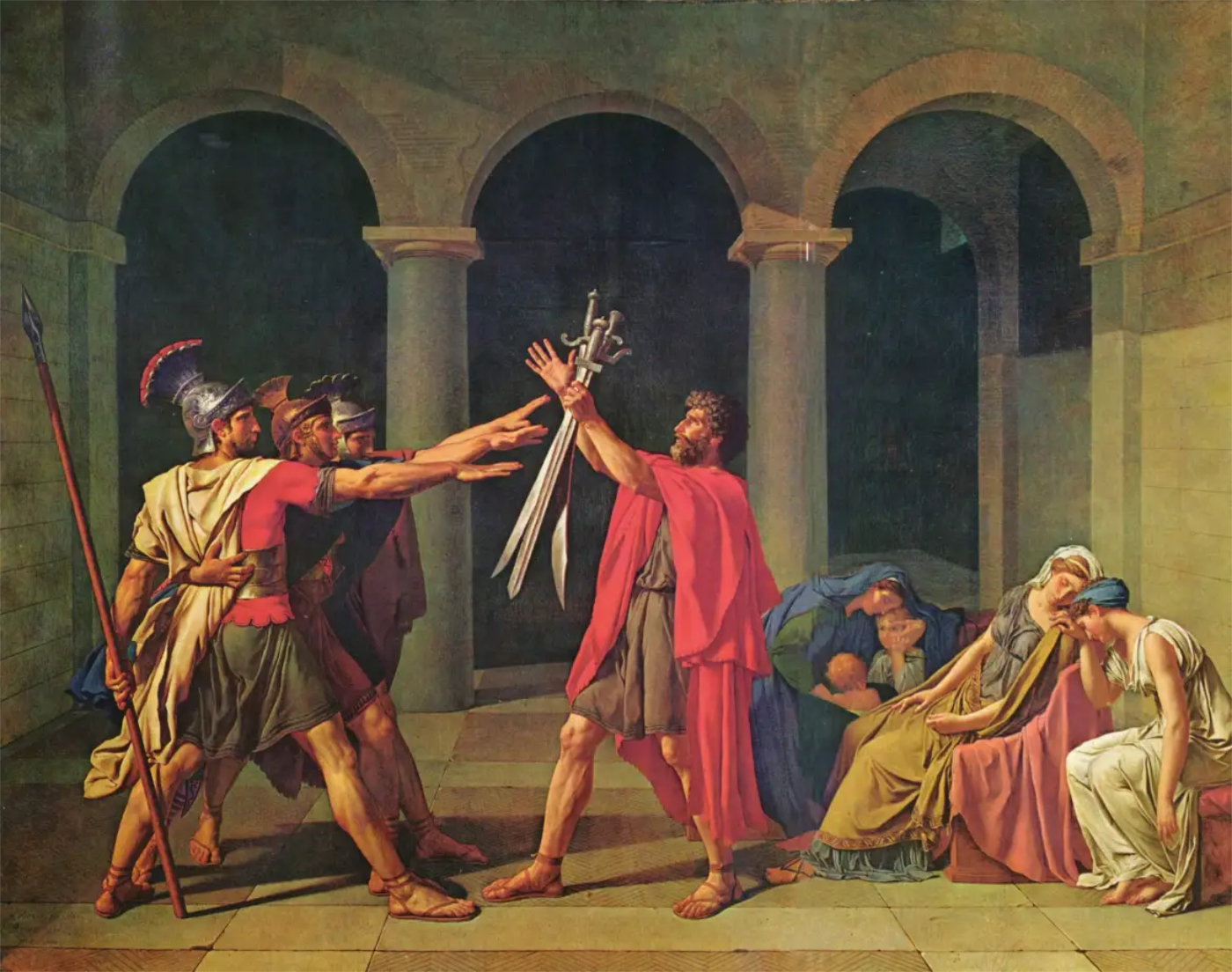
Their father’s right hand is open in willingness to make this sacrifice too. The father stands before the central arch with a large, flowing red cloak wrapped around him. This red is the strongest color in the painting and is echoed in the top worn by the first brother. Red is symbolically the color of love, sacrifice, and martyrdom.
Before the arch to our right, three women sit, languid and collapsed. One of them tries to comfort two small children. The two other women seem barely able to console each other. They repose in sharp and dramatic contrast to the dynamic and active stance of the three brothers. Weakness is dramatically contrasted to strength and, as a result, the weakness seems somehow even weaker, and the strength seems somehow so much stronger.
As drawn by David’s hands, “The Oath of the Horatii” is classically perfect and precise, convincingly real but dramatically idealized. As felt in David’s heart, we can almost hear the three brothers crying out, “Liberte! Egalite! Fraternite!”
David was involved in the ideas and ideals of the French Revolution with an ardent zeal and a religious fervor. We feel that most strongly in his warm and loving painting of an idealized martyr, a contemporary saint assassinated in the struggle for “Freedom, Equality and Fraternity.”
Jacques-Louis David’s “The Death of Marat“ was painted in 1793. The physically ugly politician that was Marat is transformed here, in David’s Classical hands, into a beautifully noble young man killed by a fanatical royalist, Charlotte Corday, while he was working for the dignity of his brothers and sisters, writing even while in his tub. Marat was martyred while soaking in his medicinal bath, seeking healing for his ugly skin disease. This strong leader of the French Revolution was ambushed at a moment of vulnerability and weakness by a madwoman with a knife.
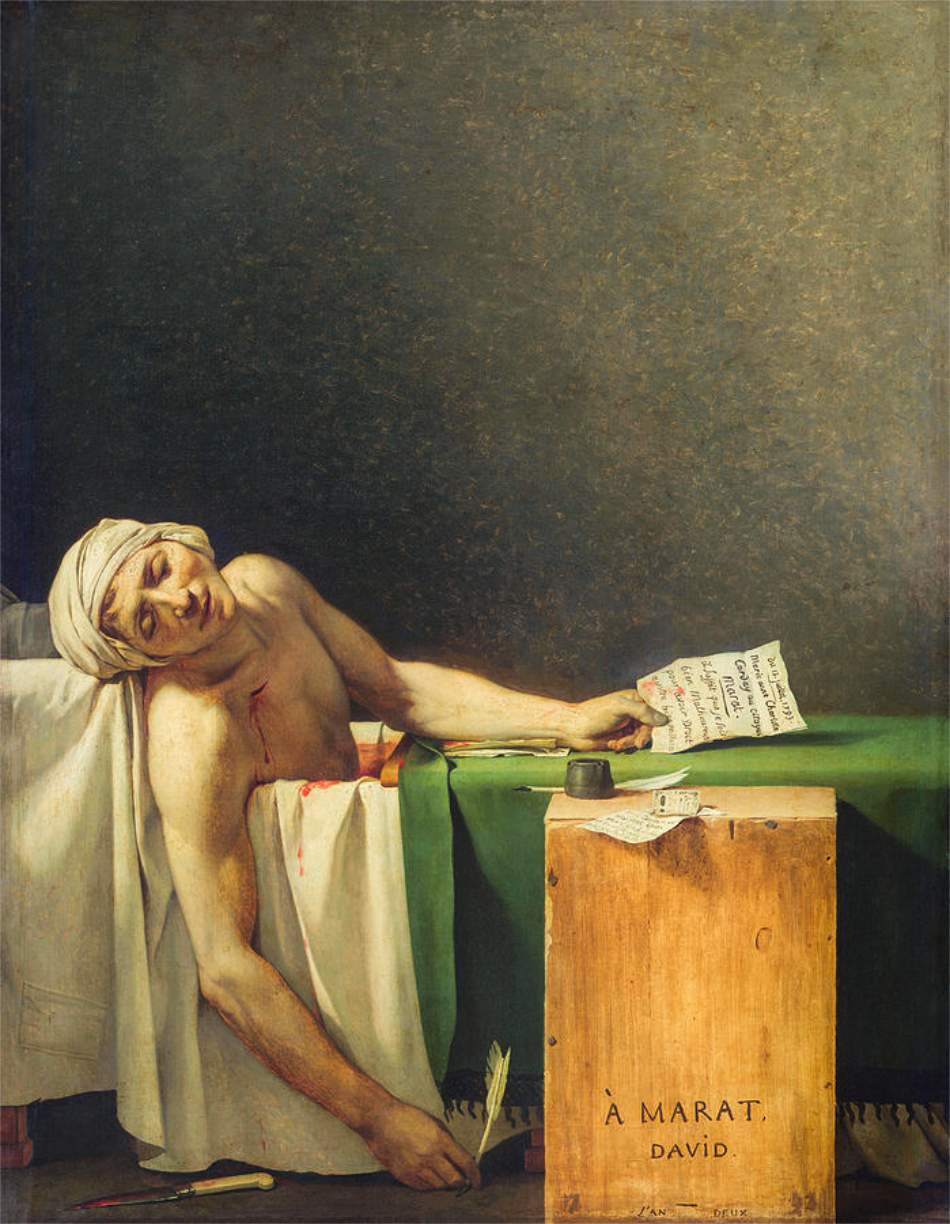
The quill is still held lightly in the fingers of his right hand, which rests upon the floor. To the left of the quill, we see the murder weapon, the blood-stained knife. In Marat’s left hand is a sheet of paper which bears the name of the woman who killed him. Light shines on the muscular flesh of his arms and chest. Light shines on his head, which is wrapped in a towel, and he leans gently on the back of the tub. Light shines on his face which, even now, even in death, is beautiful and young and pure, somehow strangely sacred and serenely at peace. He has fought the good fight. Indeed, he has been slain while fighting the good fight. There is one red gash on his chest, above his heart.
This painting could be a portrait of St. Sebastian pierced with arrows, martyred for upholding his Christian faith. David uses no Christian symbols here, but the appeal to saintliness is strong. Even the brightening light shining in the top right corner of the painting suggests the glory to come for Marat in future life. Those who die for the Lord shall live with the Lord. Those who have given their lives for the common good are now forever at peace. They are now forever home with God. And God is, once again for us, in the gentle, whispering wind.