Gabriel Faure (1845-1924) found Berlioz’s “Requiem” overly dramatic and indifferently religious. Faure’s own “Requiem” (1887) is indeed a kind of answer to Berlioz’s kind of music. Faure’s work is scored – in addition to the soprano and baritone solos and the choir in four, occasionally divided to six, parts – for violas and cellos divided, supported by double-basses and the organ playing a kind of continuo part, with horns and trumpets in a few sharply defined entries, a harp in only three of the seven movements, and no other strings except a single violin solo in the “Sanctus.” The effect of this orchestration is to match the liturgical purpose of the work with the restrained expressiveness that comes of a sparing use of higher and heavier musical sounds.
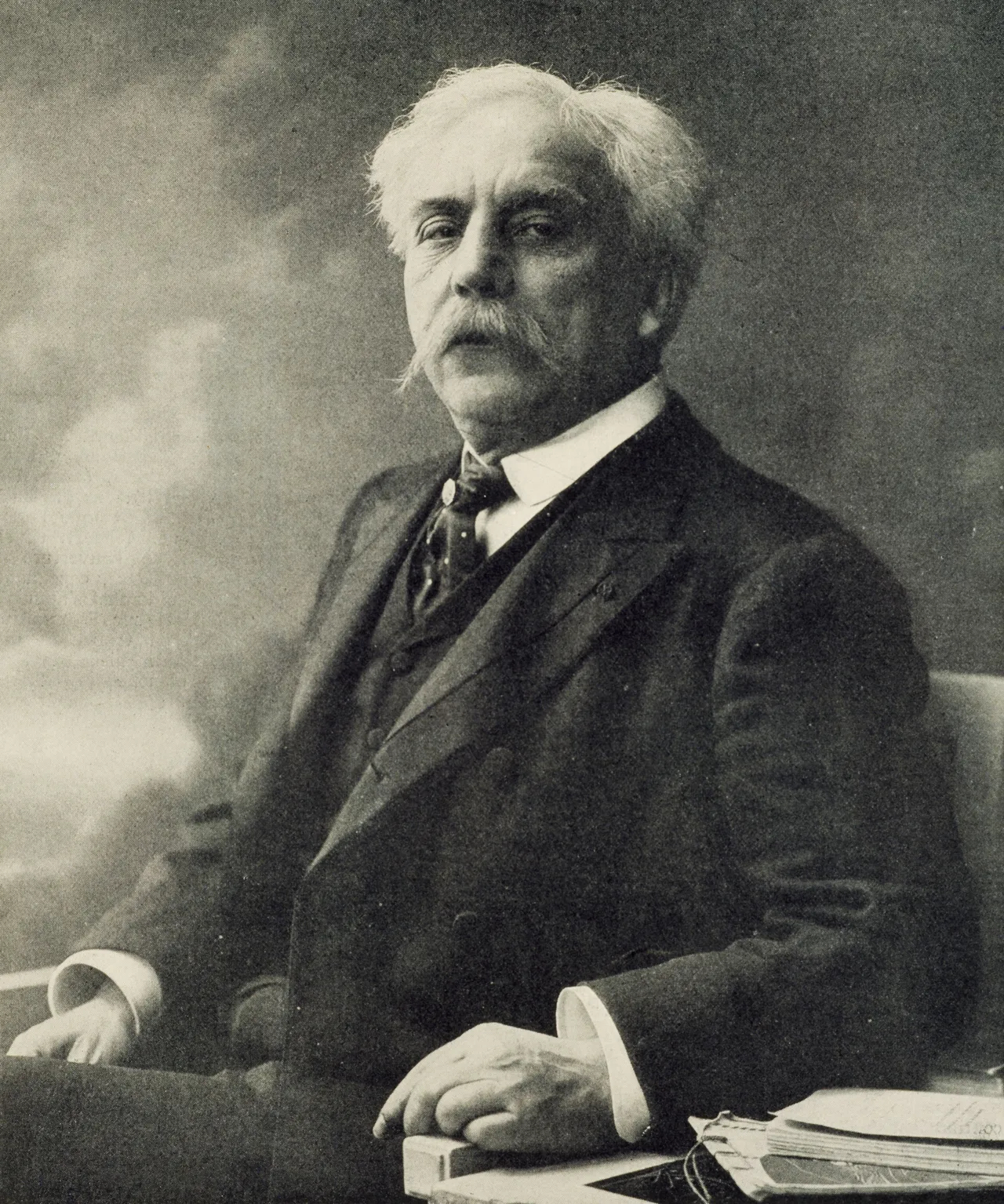
Faure’s “Requiem” is, in fact, what hardly any of the great composers’ “Requiems” had been in the century elapsing since Mozart. It is suited to liturgical use, to being sung in church; it does not ask to be a concert work. It illustrates Faure’s masterful use of the great force and beauty of medieval chant modes, as well as his mastery of unpretentious innovations in musical language. It is, moreover, standing proof that these two features are but facets of the same power to communicate prayerfully.
Faure’s “Requiem” is a musical expression of the great dignity, the confident hope and the peaceful serenity inherent in the Christian view of death as a passage into eternal life in Christ. It is also great music, alive and thrilling, new and real. It is good evidence that the two words that form the phrase “ecclesiastical music” need not be dichotomous terms.
It is true that one does not find in Faure’s “Requiem” the magnificence of formal structures that one finds so abundantly in Mozart’s “Requiem.” It is even more true that one does not find in it the sometimes psychedelic coloration of Berlioz’s “Requiem” or the drama and theatricality of Verdi’s. In Faure’s “Requiem” there is none of the passionate terror of Verdi’s “Dies Irae” (Ed note: Judgement Day) or the splendiforous brazen bombast of Berhiozs “Tuba minim.” In Faure’s “Requiem” there is, in fact, no “Dies Irae” at all! In more than one sense, then, Faure’s “Requiem” is, more than any other, a Requiem without the horror of the Last Judgment.
For Faure the omission was decidedly deliberate. He was far too conscientious a composer to have left out the “Dies Irae” casually. Faure was not being defiant of existing Tridentine liturgical norms in omitting the “Dies Irae” from his “Requiem” (and, in fact, he knew that the medieval chant “Dies Irae” would be sung whenever his “Requiem” was used at an actual liturgical service) but he was, simply and sincerely, expressing in his music what he thought the essence of the Requiem Mass was.
Faure was undoubtedly closer to the genuine traditional Christian truth. After all, the “Dies Irae,” so understandably emphasized by all the more dramatic composers, had only been added to the Requiem Mass in the middle of the 13th Century. As such, the medieval sequence was the latest section to be included in the Requiem and was always a rather blatant contradiction of the themes of hope, trust, rest, and peace so prevalent in the other, older texts of the Mass. Faure showed a theological understanding older than Trent and older than the Middle Ages of Christendom in omitting the prayer.
It is interesting to note that, as a result of the liturgical renewal inaugurated by the Second Vatican Council in 1963, the “Dies Irae” was initially made optional and later removed entirely from the Requiem Mass. Faure was not being avant-garde in omitting the medieval sequence some 75 years before the Church, however. He was not trying to be modern. He, like the Council, was trying rather to renew a Christian concept of death more ancient than medieval fire and brimstone. Faure’s “Requiem” expresses the faith of the mourners who prayed in the catacombs with confident hope in their Risen Savior.
The strength and the charm of Faure’s music is rooted not in dramatic orchestrations but in his use of long serene melodies, his use of basses with subtle and untroubled rhythms and in his command of repetitive devices and, most importantly, in his power to build magnificent spacious structures out of these elements.
The choir practically whispers the opening phrases of Faure’s “Requiem.” The rest and the peacefulness of the first word is, for Faure, the key not only to the opening phrase but to the entire Requiem Mass. To emphasize the gentleness of the choir’s prayer all the more, Faure separates their hushed phrases by unisons marked fortissimo for woodwinds, horns, and strings. Then sustained notes in violas, cellos, and basses accompany the choir marked pianissimo as they sing, “Requiem aeternam dona eis, Domine… Eternal rest grant unto them, O Lord…” There is a slight crescendo on “et lux perpetua luceat eis… and let perpetual light shine upon them…” but this fades quickly into the final “luceat eis” which is marked ppp.
The tenors repeat the opening phrase with a lovely, chant-like phrase marked dolce expressivo. The psalm verse, “Te decet hymnus,” sung by the sopranos is also reminiscent of chant. Although Faure makes no direct quotation from the chant Requiem in all of his composition, many of his melodic phrases (like many of Victoria’s and Palestrina’s) seem to have flowered from the rich soil of the chant. There is more powerful emphasis on the choir’s “exaudi, exaudi orationem meam… hear my prayer.” But all is very hushed once again as the Introit concludes with ” Ad to omnis caro veniet… to you all flesh shall come.”
The text of the Introit is not concluded with a final cadence in Faure’s “Requiem” but moves musically right into the “Kyrie.” And the “Kyrie” is not a double-fugue like Mozart’s, ethereal in its magnificent classical strength. Nor is it a proud, angry shout for mercy like Verdi’s, with its powerful beauty boiling in strong human passion and hot confusion. Faure’s “Kyrie” is not a musical tour de force at all. It sounds rather like a confident prayer to a God whose name is Love and whose heart is therefore necessarily full of mercy.
Once again, God has been discovered not in the hurricane, not in the fire, not in the earthquake, but in the gentle, whispering wind.