Sometimes the dreams we dream seem more intensely real than the more normal, ordinary reality which once again confronts us upon our awakening. The exquisite painting skills of Salvador Dail (1904-1989 ) empowered the artist to render all flesh as extraordinarily palpable and, indeed, all material things as magnificently real. His bizarre imagination and his obsession with the Freudian subconscious, however, moved him to render reality as fantastically ephemeral and dreamy. Dali’s art, then, is best described as surrealistic. It is the stuff of which dreams – and often nightmares – are made.
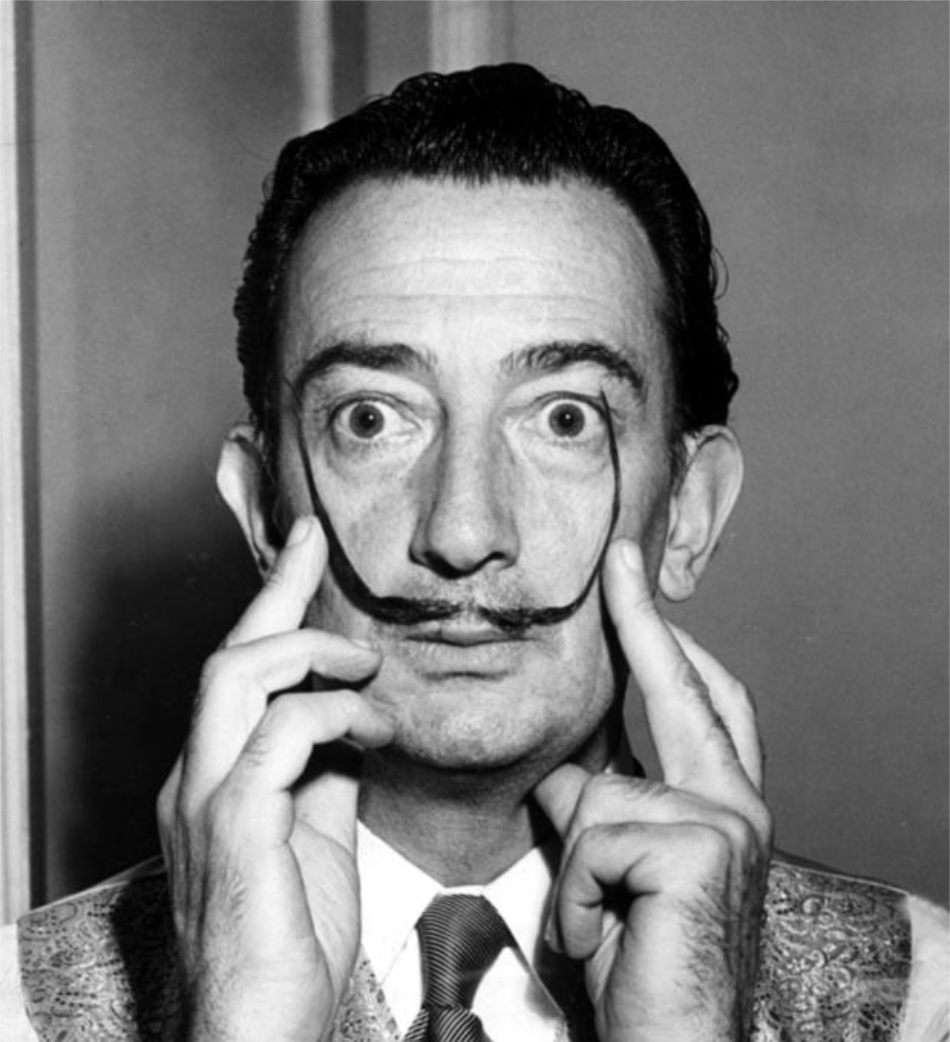
And, perhaps surprisingly, some of Dali’s paintings in the 1950’s are also the stuff of which prayers are made. The agnostic and anarchistic Dali seems to have awakened to a new consciousness in the 1940’s, influenced undoubtedly by the terrible ordeals of the Spanish Civil War and World War II. He was changed as well by a reappraisal of Freud after meeting the man in 1938. At the same time, Dali discovered a new interest in classical art, especially the paintings of the 17th century Spanish master, Zubaran. For these and for whatever other mysterious reasons, Dali in the 1959s painted Christian symbols provocatively, prayerfully and beautifully – and, of course, surrealistically.
Dali’s “The Madonna of Port Lligat” (1950) is lavishly rich in Christian symbolism. Mary, the Mother of Jesus, seems to be seated upon a very strange throne. Her hands are poised in prayer, exquisitely, very gently, fingertips barely touching, hovering protectively and prayerfully over her son, Jesus. The fair and beautiful young boy is apparently seated upon his mother’s lap. Mary, modeled by Dali’s wife Gala, is framed by broken, ancient, floating arches above and thick marble slabs at her sides, but there seems to be no seat beneath her. Jesus also appears to be seated only. He actually floats about an inch above his mother’s lap. Everything – and everyone – seems strangely suspended in space.
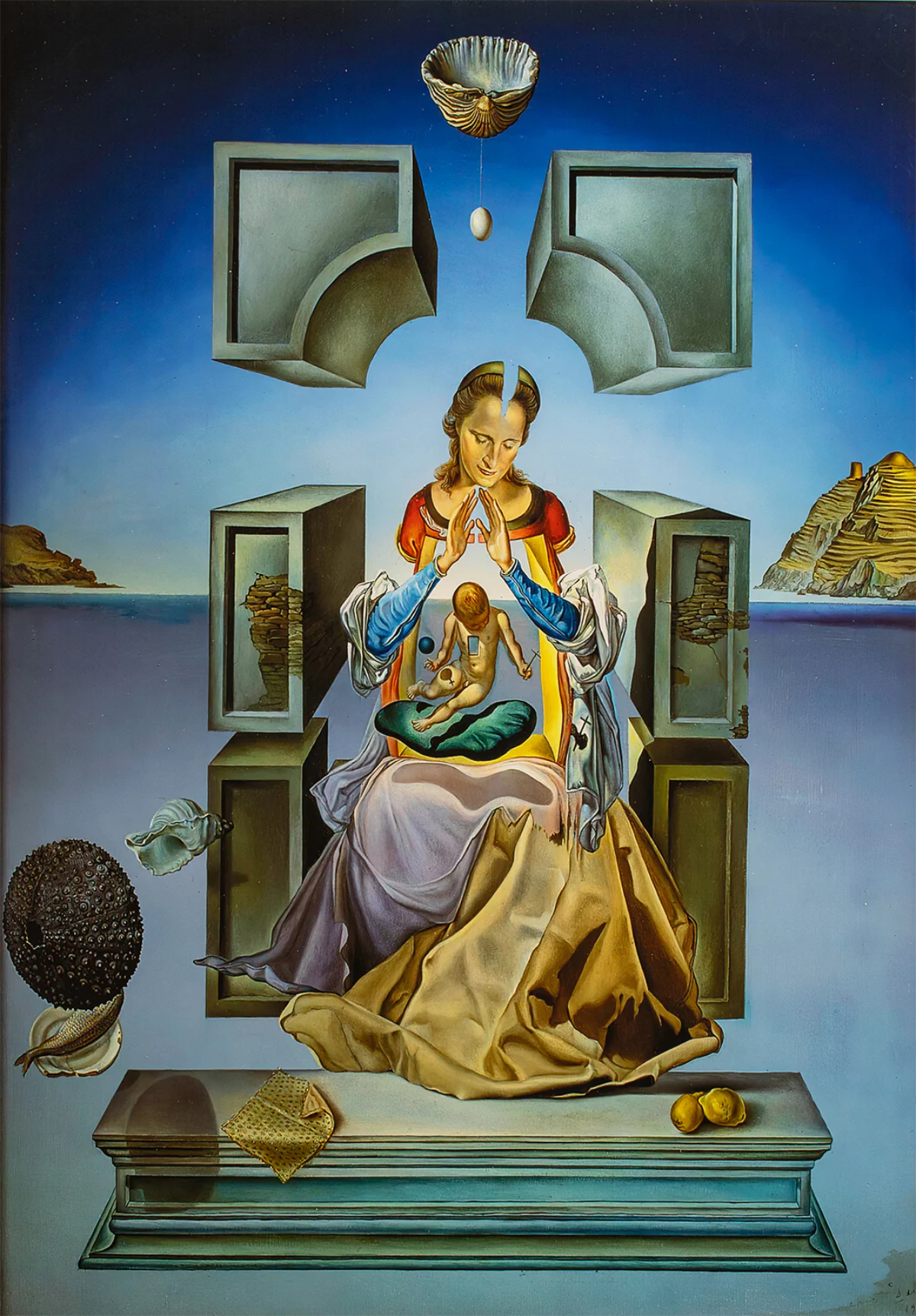
The boy Jesus is looking down at his body and, specifically, at an actual picture frame which hollows out his chest. We look right through this frame and then through another picture frame which hollows out Mary’s chest. In the open space which literally passes through Madonna and Child, we see a piece of bread, floating, suspended in air. This eucharistic symbol is, wondrously, at the very heart of Jesus and at the very heart of Mary. The Christian believer hears Jesus say over and over and over again, “Take this bread and eat it for this is my body given up for you.” The Christian congregation still sings the ancient hymn, “Ave verum corpus natum de Maria virgine… Hail body truly born of the Virgin Mary.”
We look through Jesus and Mary, embracing the Eucharist, to the shore and the sea where islands seem to float. Dali uses as his background here a seascape which he uses often: the craggy bay of Port Lligat in his native Catalonia. The setting is a real one. The mother and son are real people. But we find ourselves in a strange, mystical dream. We find ourselves on the verge of a deep eucharistic prayer.
Many other Christian symbols move us in the direction of that prayer. For example, we look straight down the center of the painting, down from Jesus’ foreshortened left foot and we see, first, a sheaf of wheat, then two mystical white roses, a nuclear cross and, finally, a shell for baptizing into new life. We look back up to the top of the painting, and we notice another shell. This open white shell hovers above the figures of Mary and Jesus. Suspended from the shell, on a long string, is what looks like a white egg. The egg is a symbol of birth and new life, of course, but it is also an allusion to the way the Eucharist was reserved in ancient churches, suspended from the sanctuary ceiling by a string, in a small, white, egg-shaped tabernacle.
How can any artist or poet or musician or theologian portray the Eucharist as literally, really and truly the body of Christ? Words alone are inadequate to the task; otherwise, people would not have walked away from Jesus, muttering in disbelief, “How can he possibly give us his flesh to eat?” It is true that Faith alone is adequate to embrace the experience. But how can that faith-experience be portrayed? Neither scientific terminology nor realistic painting can reveal very much about something which is essentially a profound spiritual mystery. Music can certainly help, for music is the freest of all the arts, the most spiritual, the least locked into all that is material. And abstract art, of all painting, is most like music. We have seen that in the art of Kandinsky. And here, in this new, mysterious realm somewhere between realistic art and abstract art, we see it again in the surrealistic art of Salvador Dali. We are strangely freed and prodded and provoked to move deeper into our hearts where faith embraces what is unexplainable.
In Dali’s “Madonna of Port Lligat,” we are persuaded to move through the hearts of Jesus and Mary to the Eucharist which, we believe in our hearts, makes us one in communion with our God, our God who is Love. The Eucharist makes us, all of us, as Paul says, woman or man, gentile or Jew, servant or free, one bread, one body in the Lord. The love-gift Jesus makes of himself for us, on the cross and in the Eucharist makes us one. We are in communion with our God and with one another.
In Dali’s “Corpus Hypercubus” (1954), an eternal vision of the eternal gift of Jesus on the cross. Dali, in his struggle to find faith, uses a style which he calls “nuclear mysticism.” Eight huge cubes are combined to make the cross upon which Jesus is crucified. Jesus himself takes the place of the ninth cube
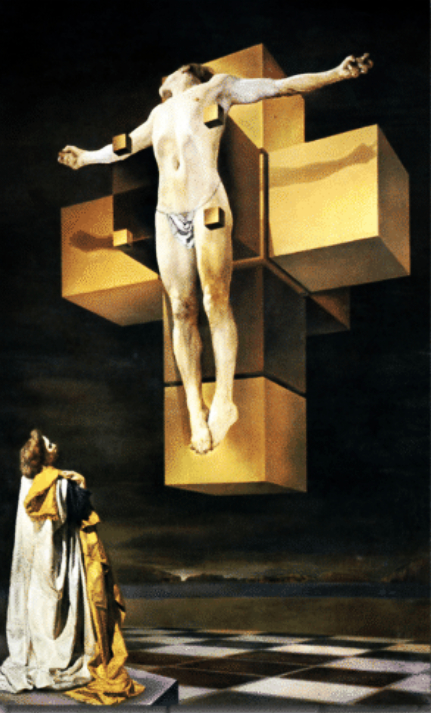
The body of Jesus is strangely perfect and unscarred. His body is not only perfectly painted by Dali, but his body is also in perfect physical shape. We see no marks from the metal-tipped scourges with which his back and his chest and his legs had been whipped. We see no marks from the long sharp thorns which had been stuck into his head. We see no wounds where the great iron nails had been hammered into his hands and his feet. We see no gaping gash where the Roman centurion’s spear had been plunged into his heart.
The body of Jesus is not even attached to the cross. His body floats strangely free in front of the cross. The four small cubes floating in front of the body of Jesus are, perhaps, symbolic of the two nails in his hands, the one nail in his feet, and the spear in his side. But his body is perfect. His gift is eternal. This is not a historical scene, no more than Michelangelo’s 1498 “Pieta” in St. Peter’s in Rome is. This Dali, like that Michelangelo, offers us not one moment of history to remember but an eternal communion to contemplate, a gift of love to celebrate and share.
A lone figure stands, wrapped in golden garments, to our left of the cross. The figure could be Mary, the Mother of Jesus. The figure could be John the beloved disciple. The figure could be any human being or every human being. Dali again uses his wife Gala as the model for this lone figure contemplating the cross and the Crucified. She stands there for all of us, for each of us. She stands for the Christian who believes and who contemplates her savior with faith and with love forever.
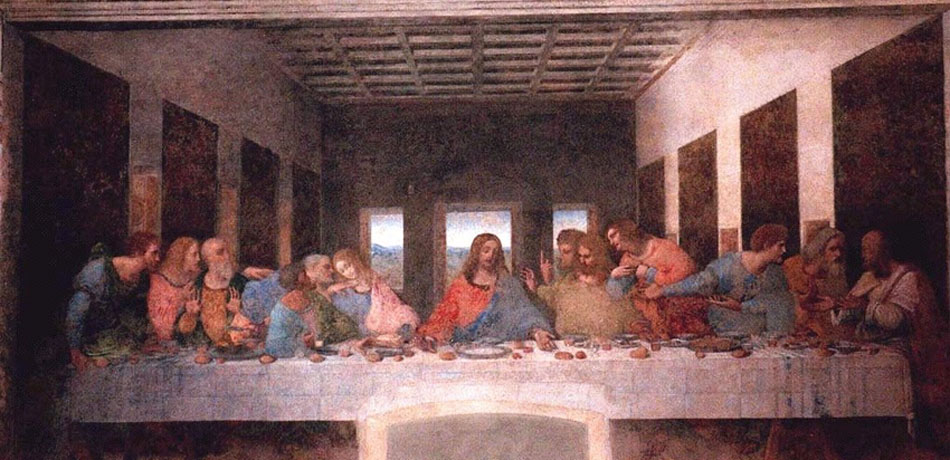
In Dail’s “The Sacrament of the Last Supper” (1955) we are again invited to contemplate the same mysterious communion in another surrealistic guise. This is, again, not an attempt to depict historically the meal Jesus shared with his disciples the night before he died. This is, rather, an attempt to capture the eternal sacramentality of communion with the Lord.
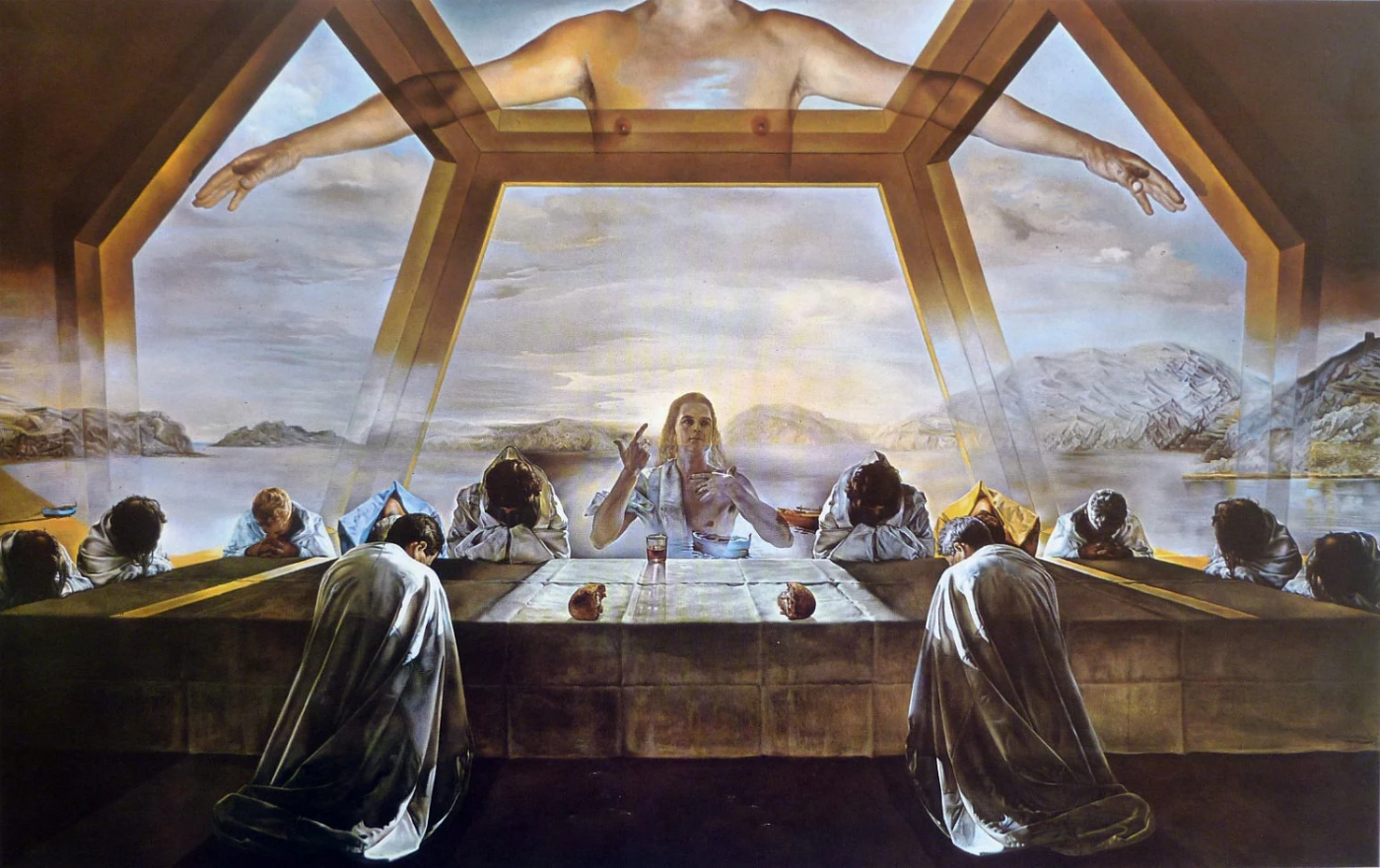
The twelve disciples gathered around the table are in perfect balance and symmetry. The postures of the six disciples on the left side of Jesus are a perfect mirror image of the postures of the six disciples on his right. Dali insists that “communion must be symmetrical.” The twelve disciples are also clothed in white robes that could come from any time or from no specific time at all. For the disciples in Dail’s “The Sacrament of the Last Supper” are us.
Jesus is in the center of the long table. The table is covered with a long white cloth which bears the marks of its having been, until very recently, folded in a linen closet. All that is on the table is one loaf of bread broken in half and one half-filled glass of wine. They are both in front of Jesus, and they look real. But we notice that light from the rising sun outside the room shines right through the body of Jesus. Light shines through the body of Jesus and then through the glass of wine which is in front of Jesus. The wine looks real, but Jesus looks transparent. There are marks on the tablecloth, but there are no marks on the body of Jesus.
Looking more closely, we notice that the two boats floating on the bay beyond the room are visible through the body of Jesus. The bay is again, not surprisingly, the Port of Lligat. But the body of Jesus is, surprisingly, transparent. We see part of one boat through the left side of his chest and part of another boat through his left arm. Jesus has no beard or mustache and his long hair is dark-blond and wavy and falls behind his shoulders.
The left hand of Jesus is spread wide and points to his heart, to the center of his being. His right hand points up through the dawn sky to the top of the painting. Here, through the transparent frame of the geodesic wall which seems to both close in and open out, we see the upper torso of a man who is also transparent. The blue of the morning sky shines through his chest, through the center of his being. The man seems to be floating up and out of the painting. His arms are outstretched in a gesture of both crucifixion and rising.
In the 14th chapter of John’s Gospel, Jesus, seated at table with his disciples on the night before he was to die, said to them, “I am going now to prepare a place for you …. Do not let your hearts be troubled. Trust in God and trust in me. There are many rooms in my Father’s house. If there were not, I should have told you. I am going now to prepare a place for you, and after I have gone and prepared you a place, I shall return to take you with me, so that where I am, you too may be.”
In Dali’s “The Sacrament of the Last Supper,” we are moved again to remember… to celebrate… to believe… in our eternal communion with God who is Love…
We have been moved to experience the sacred through masterpieces of music and art. Through these many varied and provocative voices and images, we have been moved to experience God who is not in the hurricane, not in the earthquake, not in the fire… but in the gentle wind.