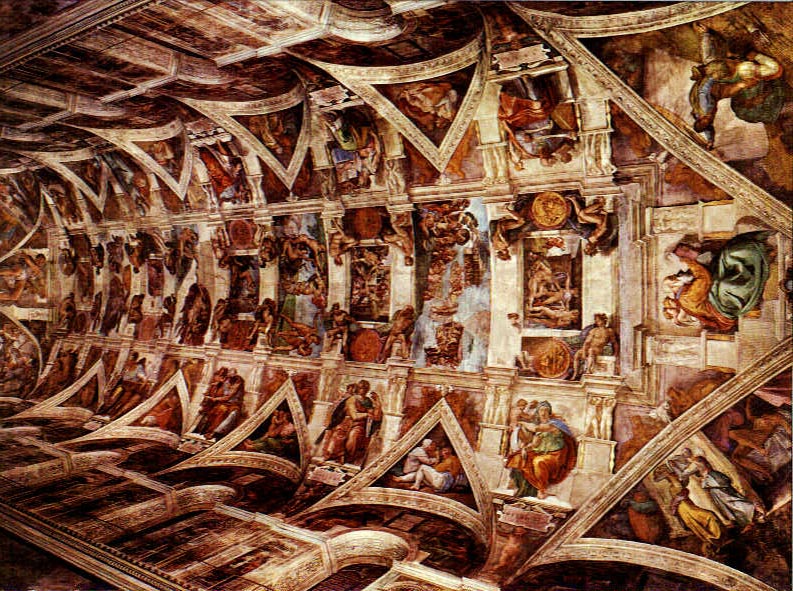
We fly back to Rome, enter the Sistine Chapel and stare up at the ceiling in awe. We look at Michelangelo’s pictorial representation of the Genesis story of human creation. Three enormous insights overwhelm us:
God is not alone
Adam is
But not for long
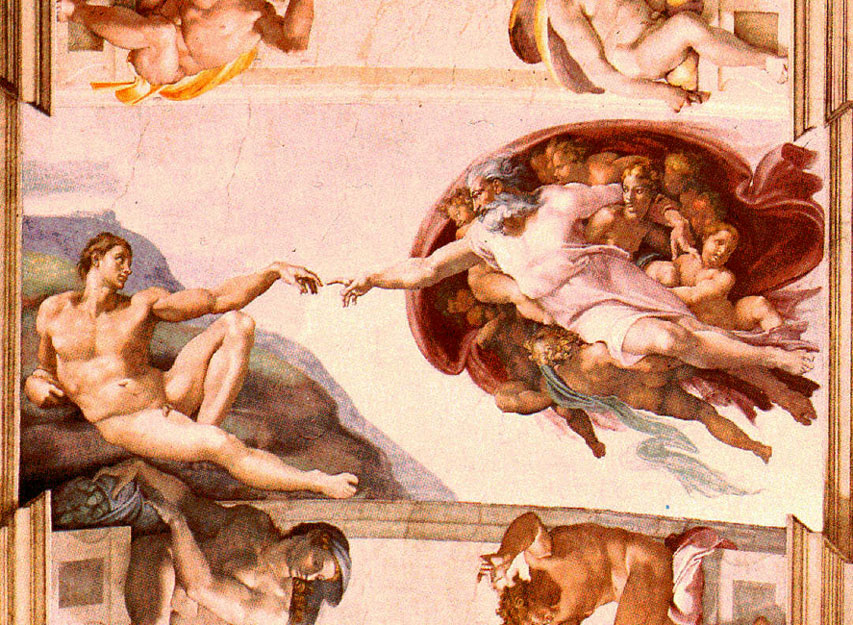
Michelangelo has depicted the Creator in some mysterious, mystic community of relationship. God sweeps across vast, eternal space surrounded by other beings, angels perhaps, huddling close around God. The billowing shape of this community is convex, like an eye, full, outgoing, giving. The left arm of God is warmly, protectively wrapped around a special being. She is lovely and feminine and her eyes are wide open with expectation. Together, this community of persons moves toward the lone figure at the left.
He is Adam, and he is alone. His body is perfectly formed but limp and lifeless.
His face seems sad with longing. The shape of his figure is concave, like a bowl, waiting to be filled. His left arm rests on his knee and his forearm and hand and index finger all hang, suspended, not moving, not yet alive, not yet human.
And then the touch! Michelangelo has captured in fresco one magnificent, breathless instant. The right hand of God is reaching out, moving in towards Adam. God’s right index finger is extended. The tip of God’s finger is a fraction of an inch, a breath, a heartbeat away from the tip of Adam’s lifeless finger.
In Genesis, the Creator says, “Let us make humans in our own image: male and female God created them…: And God saw that it was good” We read Genesis and marvel at the powerful simplicity of the story of creation. We look at Michelangelo s “Creation of Adam” and realize that this particular image is nowhere to be found in the Bible. Michelangelo hoc fecit. Inspired by God, Michelangelo has created this. And it is perfect. It captures, as a painted image, what the Sacred Scriptures reveal in words. It is so right that we wonder how it could have been imaged any other way.
Michelangelo had already depicted God flying around space, making huge spinning orbs for the sun and the moon, images which come quite literally from Genesis. But how could human creation be painted as described by the words of Genesis? Could the Creator be painted kneeling over a pile of dust, blowing his breath into the dirt? What muddled impression would this give to the believer standing 66 feet below, looking up and wondering what it all means? No, the image had to clearly convey what the story conveys.
And what does the creation story of Genesis convey? It is important for us to realize that the Bible is not a scientific textbook. It is a religious, theological, spiritual inspiration. The truths the Bible reveals are not geological truths but theological truths. The Bible is not intending to tell us literally how the world was made. It does not tell us, for example, that God split an atom of geopitomachiton and cyclotroned the molecules through the filtrations of an enormous black hole until there were three cubic centimeters of protoplasmic luminosity left. If the Bible did attempt to speak scientifically, who would have understood what it was saying? Certainly, none of the nomadic, primitive people for whom it was originally written could possibly have understood such language. And, truthfully, few of us living in this modern scientific era would understand it either.
In fact, there are two different, and literally contradictory, accounts of creation in the first two chapters of Genesis. Two different oral traditions of the story of creation were handed down from age to age. And when the time came for the story to be written down, the inspired author, rather than making a choice of the A tradition or the B tradition, simply chose both. This is another delightful indication that the authors of the Scriptures did not share our modern ideals of scientific accuracy. Again, the Bible is not conveying scientific truths but religious truths.
And the religious truths conveyed by the Genesis accounts can be summarized as three:
God made everything.
Everything God made is good.
Human beings, made in the image and likeness of God, are the height of God’s creation
Michelangelo understands this and, in the glorious freedom of the children of God, conveys the religious truth of the scriptural account, rather than the literalness of the scriptural words which were never meant to be taken literally anyway. Michelangelo depicts a God who is relational, creating human beings who are made in the image and likeness of God to be relational, to be loving, to be loved. God’s left arm is warmly embracing the expectant Eve. God’s strong right arm reaches out to Adam to give him life, to give him Eve, and to give Eve Adam.
Michelangelo surprises us all by depicting God in this one fresco as practically naked, covered only by a diaphanous shirt. Michelangelo, always, in all his works, sees the naked human body as revealing the glory of God. And in this wonderful painting, Michelangelo emphasizes how deeply and intimately we share life with God and with one another, we who are made in the image and likeness of God.