 God in the Gentle Wind
by
Rev Charles J. Matonti, Ed. D. (1935 – 2025)
INTRODUCTION
The prophet Elijah once walked forty days and forty nights on the strength of the food and drink with which the Lord God had provided him. And on the strength of his faith in the Lord, as well as the strength of that food and drink , the prophet at long last reached Mount Horeb, the Mountain of the Lord. Exhausted, Elijah crawled into a cave on the mountaintop and fell asleep. He was awakened by a wonderful message ringing in his head and singing in his heart, “Elijah, Elijah, go outside and stand on the mountain before the Lord for the Lord will be passing by.” Elijah was very excited and not a little frightened. He didn’t know what to expect. How would the Lord pass by? How would Elijah recognize God? What if he missed the Lord completely? Then what? What should he do?
“I should just wait and trust the Lord,” Elijah decided. “I may not know what to do but the Lord certainly does. I’ll wait and trust the Lord.”
Elijah did not have long to wait. Suddenly, a huge, thundering hurricane came tearing through the mountains, ripping them apart with great power and violent crashing sounds as mighty rocks were crushed before the coming of the Lord. Scared almost to death, Elijah hid inside the entrance of the cave with his hands over his ears and his heart pounding in the trembling hollow of his chest. Is this how the Lord was coming, Elijah worried, but no, he knew, somehow he knew that the Lord was not in the powerful hurricane. Elijah breathed a sigh of relief.
Then all the earth began to tremble and shake and roll away from under his feet. Elijah tried desperately to hold on to a ledge on the wall of the cave. But how long could he hold on? The whole world was collapsing all around him in an enormous earthquake. Could the Lord God be in the earthquake? There were tears in Elijah’s eyes now, but somehow he knew that no, the Lord God was not in the earthquake. In a while, the earth grew still again. And Elijah dried his eyes.
As soon as he took his hands away from his eyes, however, all Elijah could see was fire, tremendous flames blazing all through the mountains, whistling, leaping, licking the broken rocks with huge, horrible tongues, scarlet and yellow and purple. The smoke and the heat were unbearable. Could the Lord God possibly be in this fire, Elijah wondered? But even as he wondered, he knew. Somehow, in faith, he knew that the Lord God was not in the fire.
Once more, Elijah waited for the Lord to come. The Lord had promised. Elijah trusted in the Lord’s promise and waited. After just a few minutes of waiting, Elijah thought he heard something. But he could hardly tell what it was. It was barely audible at first. It was so gentle, so tender, like a mother crooning to her baby at her breast. It was so lovely, so comforting, this soft, murmuring sigh, this warmly moving music, this gentle, whispering wind. And Elijah knew with all his mind, felt with all his heart, believed with all his faith that the Lord God was in the gentle wind
And so God was.
And so God is. Today, for us too, God is in the gentle wind. Like Elijah, we can look and do look for God’s manifestation in cataclysmic occurrences, in our contemporary hurricanes and earthquakes and fires and their personal emotional equivalents in our lives. Frequently too, like Elijah, we find God missing or, to phrase the experience more accurately, we miss God’s presence. It is humanly reasonable and understandable.
It is understandable that human beings continue to expect the Mighty One to come in what human reason and imagination compute as an appropriately mighty way. But “God’s ways are not our ways,” as the Psalmist has been singing for thousands of years. What is humanly reasonable is so small compared to what God knows to be really real. Paul assures us that “God is bigger than the human heart” and also assures us that we are “God’s works of art.”
That God’s ways are not our ways usually comes to us “works of art” as a big surprise because God continues to come to us in surprising, and surprisingly gentle, ways.
God comes to us, for example, in Michelangelo’s Bruges Madonna, on the pudgy feet of the boy Jesus. We are surprised to find ourselves smiling with delight at the imperfect, perfectly human feet of the Word made flesh. Then God comes to us in the pensive pain on the face of Mary, Jesus’ Mother. And we are surprised again to find our hearts hurting as we study the Madonna’s expression. Why does the Mother of this wonderful little boy look so terribly sad? Slowly our eyes move to Mary’s hand holding a book, a book which speaks movingly of the Messiah as Suffering Servant. Then our eyes note with tenderness the hands of Jesus clutching his Mother’s fingers and her leg even as his feet and his face show the boy to be eager to jump down and move into the world And, once again, God comes to us in the gentle wind.
God comes to us in the lovely high held soprano “cru-cis” and “mor-tis” in Mozart’s simple and great choral masterpiece, “Ave verum corpus.” This sacred music sings to the Body of Jesus, the Body of Christ in the Eucharist: “Hail body truly born of the virgin Mary, hail body which truly suffered and died on the cross [cruc-cis] for us, from whose pierced side flowed blood and water. Be for us a foretaste of eternal life in our death, mortis, our time of trial.” We hear soft strings and organ and mixed chorus singing this ancient Latin prayer and hold our breath as the sopranos hold their high note on “cru-cis” and “mor-tis” and, once again, God comes to us in the gentle wind.
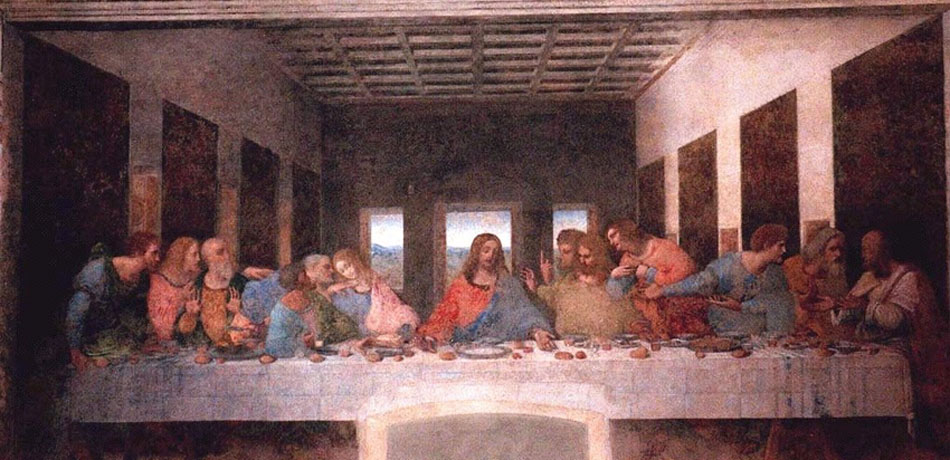
God comes to us in the plaintive mother’s wail in Gorecki’s modern “Symphony of Sorrowful Songs” and in the nestling intimacy of the sculptured lovers in Rodin’s “Hand of God.” God comes to us in the eerie and exquisite precision of Dali’s “The Sacrament of the Last Supper” and the eerie and exquisite imprecision of Kandinsky’s “Accent in Pink”
We human beings are, as Paul reminds us in another translation, “God’s masterpieces” and like God and with God, we create masterpieces of our own. Some of them are on the back walls of prehistoric caves. Some of them are still in process in our hearts. Some of them are in museums all around the world. Some of them are on the walls and ceilings of churches and chapels. We see the Creator reaching out to create human beings in God’s own image and likeness in Michelangelo’s work on the ceiling of the Sistine Chapel, and we stand in awe.
We are God’s works of art. We are created in God’s image and likeness. We are created to be relational as God is relational. We are created to be necessarily relational and communicative, loving and creative. We are created to be creative as God is creative. We are God’s works of art created to create works of art and, in some mysterious way, reveal God’s presence among us. Human beings, like Michelangelo and Mozart and Dali and Rodin and you and me, are God’s works of art. In a wonderful and mysterious way we reveal and touch the sacred in beautiful, human works of music and art. God, who is full of surprises, continues to come to us, over and over again, in the gentle wind.
Perhaps no surprise is greater than the wonderful surprise with which we begin our survey of selected works of art and music through the ages: a discovery made in 1995 of works of art painted by our ancestors in caves some thirty thousand years ago. From the very beginning, we have been God’s works of art created to be creative. From the very beginning, God has come to us, as once he came to Elijah, not in the hurricane, not in the earthquake, not in the fire, but in the gentle, whispering wind. Time after time, we have waited outside cave after cave after cave. We continue to watch and wait and listen.